
Jaguar hunted in the Alto Purus area (Photo: Diego Shoobridge)
The experience of seeing a half-skinned jaguar leaves an impression that affects not only those who love nature, but everyone who is capable of reasoning and feeling, and who has a minimal respect for the life, resources, and richness of our country. Every day there are fewer and fewer places in which the hand of man has not interfered with the original state of the landscape, leaving a devastating and irreversible mark. The systematic extraction of natural resources – and the resulting degradation of the environment – is almost always for the benefit of few and to the detriment of many, generally the poor. They are left with neither opportunities nor possibilities for the future. The harmful practice of plundering the forest for its resources reigns throughout the Peruvian Amazon. Those areas designated to guard and protect our heritage must necessarily be respected and actually achieve the purpose for which they were created.
The province of Purus contains the river of the same name, which flows into Brazil without any connection to the rest of the country. Located in the southern part of the department of Ucayali, it is one of the most isolated areas of Peru; the only way to get there is by small plane from Pucallpa. Thanks to its isolation, the natural richness of the region has been preserved for many years. In recognition its importance, the Federation of Native Communities of the Purus (FECONAPU) led a participative process through which the region was declared as the Alto Purus National Park and Purus Communal Reserve. The former was established for the protection of the watershed, its resources, and the nomadic indigenous populations living there, while the latter was created to allow the native communities settled in the region to benefit from its natural resources.
The Alto Purus National Park is the most extensive park in Peru, with an area of 2,510,700 hectares. It is connected to Manu National Park (1.7 million hectares) to the south, as well as Chandless State Park (670,000 hectares) and other reserves in Brazil to the east, forming an extensive area of strictly protected territory in the Amazonian watershed. This network of protected areas forms the most important natural corridor in the Amazon, containing a tropical forest that extends virtually uninterrupted from beyond the Brazilian border, to the Andes Mountains, about 300 kilometers to the southwest.
The zone displays a vast biological diversity, a wide variety of ecosystems, and numerous scenic landscapes. As a result, the area has been identified as a priority zone for the conservation of biological diversity in Peru. Among thousands of species, the most notable fauna include threatened and endangered species such as the giant otter (Pteroneura brasilensis), the black spider monkey (Ateles paniscus), the giant armadillo (Priodontes maximus), the jaguar (Pantera onca), the forest condor (Sarcoramphus papa), the black caiman (Melanosuchus niger), the yellow-spotted Amazon turtle (Podocnemis unifilis), the bush dog (Speothos venaticus), the boa (Boa constrictor), and the anaconda (Eunectes murinus). There is an enourmous variety of birds, insects, reptiles, and a large diversity of plant species inhabiting numerous rivers, lakes, streams, beaches, forests, and swamps. All of these resources have great potential to foster sustainable development activities, such as tourism and research, for the benefit of all Peruvians.
Over the last two decades, with a significant increase in the last five years, the level of natural resource extraction activity has negatively affected almost the entire forest, such that it no longer has the capacity to meet the demands of indigenous populations, or the society in general. This has lead those who extract these resources, especially timber, to set their eyes on protected areas and the territories of native communities. The Alto Purus, one of the few pristine territories left in the Peruvian Amazon, is not immune to these trends.
The Alto Purus is one of the few places where there is still high-quality timber, including mature mahogany trees (Swietenia macrophylla), which could serve as a seed source for reforestation efforts in other parts of the forest. The illegal removal of this species in the Alto Purus National Park and adjacent territories is intensive, despite existing Peruvian legislation and international regulations designed to protect mahogany in conservation areas and preserve it for indigenous use. Illegal logging is detrimental to the region’s ecosystem, its indigenous communities, and the natural heritage of the nation.
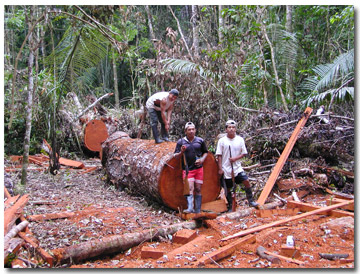
Mahogany logs and loggers in the Alto Purus Reserved Zone (now a National Park) (Photo: Chris Fagan)
Purus is practically a no man’s land, or rather, a land belonging to those who have successfully established themselves in an unprecedented system of exploitation. Loggers have established exclusive transportation routes, unjust systems of slave-like labor, and systems of exchange which place the small indigenous communities of the region at a great disavantage. These communities live in extreme poverty, without adequate health services, education, or justice, totally abandoned by the government.
The extraction of timber from their communal territories is the only resource that provides native communities with the income necessary for day-to-day expenses to buy things such as salt, sugar, soap, clothing, cooking supplies, plastic products, notebooks, etc. – those products which the forest does not provide, yet are important for their survival. With no alternative income, the native communities have been forced to make contact with timber dealers, whose numbers in the region are increasing.
The loggers arrive in these communities offering advance payments in the form of consumer goods, to be exchanged for timber. Permits for the removal of timber from the communities are required, and because the community leaders are not capable of applying for these themselves, the loggers have them sign a series of papers, which they then use to obtain the permits in the community’s name. The loggers force the communities to bear the costs incurred to obtain the permits, at exorbitantly inflated prices, thus beginning the cycle of debt even before a single tree has yet been cut.
The communities reach an agreement with the loggers to extract a certain number of the mahogany trees within their territory over a specified period of time. However, once camps are set up, the loggers don’t leave until all of the mahogany trees have been cut, continuously making new arrangements with the community leaders in order to extract more trees. Once the loggers have established themselves in the forest, they work wherever they can find mahogany trees, stretching the limits of the permits and communal boundaries. They utilize existing permits in order to remove timber which the permitted community doesn’t own. The loggers do not respect forestry management guidelines – if they even exist – nor do they respect the boundaries between communities or any other regulation.
The agreements with the natives are based on the exchange of mahogany trees in return for food and other materials. However, the loggers inflate the price of the exchanged goods. The members of the communities receive these goods before the beginning of each operation, perpetuating their cycle of debt. The logging and removal of trees continues until the communities have paid back the debt in full, at prices established by the loggers. For example, a 10-horsepower canoe motor, a device that is practically impossible for natives to acquire, costs around 1500 nuevos soles (NS), approximately US$450, but it is exchanged for eight to ten mahogany trees, whose price is 100 times that value.
The prices that the loggers pay to the communities for wood are a fraction of the market price. The loggers offer 20 to 80 centavos (~ US$0.06 to $0.24) per board foot of mahogany in the communities, while the actual price per board foot is 12 NS (~ US$3.65) when sold in Lima or 18 NS (~ US$5.48) when sold for export. In the end, the communities receive between 100 to 200 soles (~ US$30 to $60) for a mature mahogany tree, whose actual value is several thousand dollars on the international market. This system of exploitation has reached such an extreme, that some communities are far enough in debt that the loggers will remain there until 2010, or beyond, before the debt is repaid.
The only direct access to Alto Purus is by plane to Puerto Esperanza, the capital of Purus Province. It is a small town with approximately 600 inhabitants located on the banks of the Purus River. Puerto Esperanza has a paved runway used by small and medium planes originating from the city of Pucallpa, approximately 400 kilometers away. This means that the only way for wood to leave the region is by plane. This business is so lucrative, that loggers can grow very wealthy by transporting lumber from the region…
Since there is no commercial air transportation service, all of the flights are chartered, mostly by loggers, who monopolize travel to and from the region. They use these planes to transport basic necessities to the zone and carry mahogany to Pucallpa. Larger capacity planes chartered from the armed forces are used to carry timber, that is, planes which should be performing civic support flights to benefit the public are being used to transport lumber. Thus, the loggers control all movement within the region through the only existing connection between Puerto Esperanza and the rest of the country. They are practically masters of the province, transporting absolutely everything from consumer goods for the people, to gasoline and construction materials. The abuse is so prevalent, that the loggers decide who boards or doesn’t board the chartered aircrafts. There have been a series of complaints denouncing this situation, but in every instance, the loggers are more powerful, untouchable, and defiant. The local population is convinced that this situation will not change, thanks to the solid chain of complicity that exists. They wonder how far the levels of this complicity go, because they are unable to improve the situation through legal channels.
All of the people of the province of Purus depend on the loggers for travel, whether it is to do business in Pucallpa, for a health emergency, or simply to return to the city. Those that dare to complain or protest against the abuses of the loggers, simply cannot travel, and may have to remain in Puerto Esperanza for weeks or months. This is the case for a group of authorities including Subprefect Luis Lima, the regional advisor Sidney Hoyle, and 15 other people that simply don’t have the ability to travel when they need to. When these people want to leave the zone, they are forced to gather others that want to travel until they have enough passengers to fill a plane to capacity and are able to cover the costs of the charter. Upon noticing this, the loggers bring in their own charter plane to carry these other passengers, assuring that the “undesirables” (locally called “lepers”) are left behind. They even control shipments and packages, which simply never arrive if the recipient is not in the good graces of the timber dealers. Due to these methods of coercion, many prominent public officials in the province turn a blind eye toward the maneuvering of the loggers, for fear of becoming an undesirable and remaining isolated indefinitely.
This desperate situation has led some to consider the possibility of constructing a highway to connect Puerto Esperanza with Iñapari. Nothing could be more absurd! A highway would mean the destruction of Purus; thousands of loggers, migratory Andean farmers and invaders will arrive and exploit the natural resources, the local people, and the National Park. Brazil does not look favorably upon the construction of a highway adjacent to its natural protected areas and reserves, as the government recognizes the danger of illegal logging in their territory and fears the presence of drug trafficking. The history of destruction already seen in other parts of the Amazon will repeat itself. A highway will not bring any benefits, it will only lead to the plundering and exploitation of the poor.
There is also another group of loggers who are operating illegally, removing timber from the west side of Alto Purus National Park by the Sepahua and Inuya Rivers. This exploitation occurs without regard for rules or regulations. The logging activities in this zone are affecting the isolated native populations that migrate through the area. Various instances have been documented of violent encounters between loggers and indigenous populations. The natives often get the worst of it, because they are attacked with rifles, and murdered without compassion.
This illegal logging industry violates the Convention on International Trade in Endangered Species of Wild Flora and Fauna (CITES), of which Peru is a signatory nation. CITES includes the mahogany tree on its list of threatened species. Despite this, the Peruvian government continues to facilitate the exportation of mahogany by granting logging permits for the species, in obvious contradiction with this international agreement.
The logging industry operates under a powerful demand for mahogany on the part of industrialized countries. While the subsidization of mahogany has diminished in other parts of the Amazon, the logging pressure in Alto Purus and other protected areas is growing. Under these conditions, the future of Alto Purus and its local peoples is very bleak. This situation demands an effective intervention by the national authorities to regulate logging activity, end the exploitation and abuse of native populations, and punish those who are responsible. The State should guarantee the conservation of those territories designated for the protection of the natural resources that they contain and the defense of the people of the zone.
Diego Shoobridge
ParksWatch Perú
January 2006