
On May 29th, 1973, Manu National Park was created with the objective of protecting a representative sample of the biological diversity within the lowland and cloud forests, and the Andes mountain range of southeastern Peru. In addition, the park was to contribute to the recognition and protection of the cultural diversity and the self-determination of indigenous villages in the area. On May 1, 1977, the park was categorized by UNESCO as an International Biosphere Reserve, and in 1987 it was recognized as a World Heritage Site.
After evaluating the conservation status of the Manu Reserved Zone, INRENA — the government agency in charge of managing Peru’s protected areas — prepared the technical report, “Categorizing the Manu Reserved Zone – Enlarging Manu National Park.” This report served as justification for enlarging the park to 1,716,295.22 ha, and the act was officially proclaimed on July 15th, 2002 through the Supreme Decree N° 045-2002-AG.
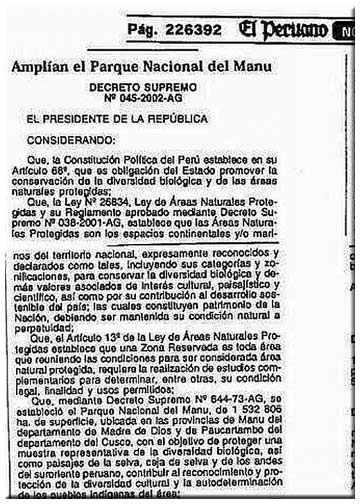
Part of Supreme Decree N° 045-2002-AG.
INRENA’s technical report determined that 194,841.75 ha of the Reserved Zone merited protection under the category of national park. In addition, the park gained 20,695.00 ha of adjacent public lands that were already the property of INRENA. The remaining 46,331.23 ha of Reserved Zone not considered in the land addendum will form part of the Buffer Zone of Manu National Park.
Manu National Park has incredible species richness. The park hosts more than 5,000 species of flora and a plethora of fauna, including nearly 3,000 species of arthropods, 200 species of mammals, close to 100 species of reptiles, 140 amphibians, and approximately 150 fish species.
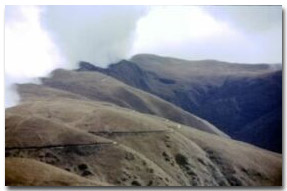
View of an Andean mountain road within Manu National Park.
(Top photo: A view from the Manu River of lowland and cloud rainforests. Both photos by Lily Rodriguez.)
ParksWatch: July 2002