
Little by little the traditional cultivation system of \”Chinampas\” is being
substituted by artificial greenhouses.
Today, February 2, is recognized as World Wetlands Day, and Xochimilco is one of the wetlands that should be thought of on this day. This natural area in the Mexican Federal District, is internationally recognized for its unique and traditional cultivation system of \”Chinampas\” (artificial islets built on the water surface to cultivate vegetables, flowers, and medicinal plants) which is compatible with the preservation of the natural habitat and wild species of the area. Xochimilco has an influx of more than two hundred million tourists each year, but in spite of the economic support this brings to the area, it also creates a serious environmental threat, including canal clogs, fires, contamination, illegal camping, and other activities such as aeromodelling and farming, that should not be carried out in an area with such high importance for resident and migratory birds.
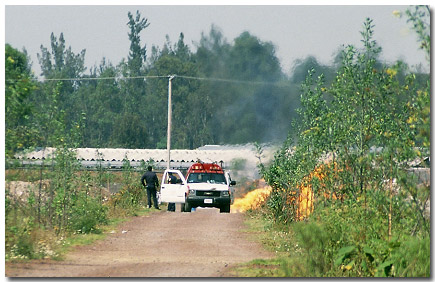
Firemen burning a gas truck that illegally entered the protected area.
It should be emphasized that in 2004 Xochimilco was included in the Ramsar Convention for wetlands, to be considered as an important site for conservation and rational use of the area\’s resources.
Xochimilco is known not only for its culture and traditions, but also for its significant biodiversity. There are 139 terrestrial and aquatic animal species, the majority of which are birds, mammals, and fish. There are 146 plant species, 115 of which are aquatic.
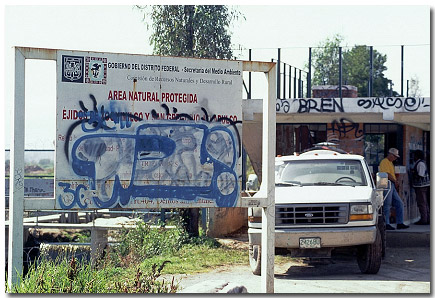
A completely deteroriated and inoperative patrol station
found in the Xochimilco protected area.
Large trucks with gravel and other construction wastes can be seen freely passing the patrol stations run by personnel from the Federal District\’s Secretariat of the Environment and police staff from the Secretariat of Public Safety, in order to dump their garbage in the area.
Days like today, and throughout the year, Mexico City\’s authorities and residents ought to ask us about the concerns they have regarding protected areas such as Xochimilco and what we are doing to reverse the contamination and water pollution problems. If we do a rough approximation we can estimate that at the rate at which canals are being blocked, lands are invaded, contamination increases, and species are eradicated, in 10 years very little will remain of the Xochimilco of yore, whose natural beauty, traditional and cultural values, earned it the status of Natural and Cultural World Heritage site by UNESCO in 1987.
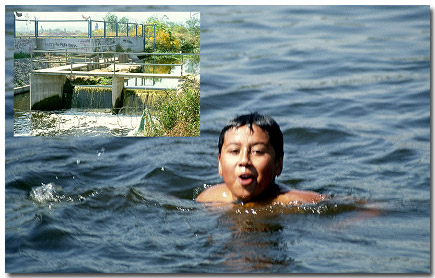
A child swims in the canal, without knowing about the high concentrations of fecal matter; chemical composites; heavy metals such as lead, chromium, cadmium, copper, and iron; and herbicides and pesticides that contaminate the water.
Gerardo Carreón A.
Director of ParksWatch-México
Naturalia A.C.
Photos: Gerardo Carreón A.
ParksWatch-Mexico: February 2005