
Junín Flightless Grebe, photo: Atlas Departamental del Perú.
Junín National Reserve (53,000 hectares), declared a state of emergency by Law 27642 (1) in 2002, remains in the same threatened condition today, two years later. At 4,100 meters above sea level, the soil of the Lake Junín (also known as Chinchaycocha), which covers the majority of the reserve, is 80% contaminated by heavy metals according to a scientific study conducted by Engineer Juan Castillo Paredes of Trujillo National University. He says, \”The conclusions of the study show presence of iron, copper, cadmium, mercury, arsenic, and lead in amounts higher than the maximum permissible amounts\”(2). This reserve is considered among one of the most important conservation areas of Peru because of its bird diversity of the high Andes region. One of the representative species of the area, the Junin Flighless Grebe (Podiceps taczanowskii), is critically endangered. The last census conducted in 2002 indicated that only 160 individuals of this species remained.
Mining History
Lake Chinchaycocha\’s contamination started at the beginning of the 20th century, with the presence of a company called Cerro de Pasco Corporation. Over the years, additional companies were established in the zone including Centromín Perú S.A., Sociedad Minera El Brocal and Aurífera Aurex Mining Company, all of which were dedicated to extracting metals. Their runoff drained into the San Juan River, one of the principal rivers flowing into the lake. The contamination continued until 1994 when the government passed Law Nº 004-94-EM/DGAA (3) protecting the environment. Despite this legal protection, the contamination remains in San Juan Río-there is evidence of iron hydroxide sediments.
Since 1994, the Ministry of Energy and Mines ordered mining companies to carry out restoration actions in Lake Junín and San Juan River. The companies Centromín and Volcán Mining Company SA implemented procedures to separate clean water, to conduct environmental impact studies, to manage the mining effluents in industrial and domestic zones, and to pump acidic waters outside of San Juan River. Today, Volcán (which has since merged with Centromín) and Brocal deposit their run-off in water treatment pools to neutralize the toxics; while these measures are commendable, the problem of contaminiation still exists because the toxics dumped over the years remain in the San Juan River sediments and leach periodically into Lake Junín .
Environmental Problems
Engineer Elvis Pineda, General Manager of ECOMUL SAC environmental consulting firm and specialist in rural development and ecology explains that the area is subjected to passive contamination or non-point contamination. During the dry months, (September, October, and November) the sediments leach out and contaminate the air, soils, nearby grasslands, and local human communities. During the rainy season, when the San Juan River waters are high, the sediments and their contaminates flow into Lake Junín.
Another factor aggravating the existing contamination and one that prevents implementation of a full solution is the Upamayo Dam, situated in the Upamayo Delta where the headwaters of Mantaro River are found. The Mantaro River is another water source for Lake Junín. The dam provides hydroelectric energy for the zone. Since its creation, soil contamination and species reductions have increased because the dam resulted in a changed water regime. When the water control gates are closed during the dry season in order to keep the reservoir full, the river flow increases bringing additional heavy metal pollutants and flooding out nesting grounds for some of the avifauna of the zone. When the water rises along the riverbanks, any existing nests are flooded and the broods lost until the next year when the same situation repeats itself.
High Andean Biodiversity
Generations of rural dwellers have seen their ecosystem being slowly destroyed. Before the \”ecological catastrophe\” as they call it, the lake was a resource for the community. They used to hunt birds and frogs, fish, and collect eggs. This helped them to survive when they were unable to produce enough through cattle-raising activities. These days, the situation is completely different. If they are lucky, they might catch a fish, there are hardly any frogs at all, and there are so few birds that hunting them is now prohibited.
Junín National Reserve is famous because it harbors three endemic species: the Junín Flightless Grebe, the Junín frog (Batrachophrynos macrostomos) and the killifish (Orestias elegans). All are threatened with extinction, not only because of contamination but also because local communities overconsume the grebe\’s eggs, they overfish, and the Junín frog is considered a local specialty (although serving it is now illegal).
There are also a wide variety of submersible plants growing in the lake making up vegetative communities found nowhere else in the world. Predominate species include poaceae distributed in groves like reed grasses (Calamagrostis sp). There are also two varieties of ichu grass, Festuca sp and Stipu brachyfilla, in addition to the reed grass (Juncus andicola) which create small islands where giant bulrush (Scirpus californicus) grows. The grasslands surrounding the lack are known as \”puna turf\” (césped de puna in Spanish) is made up of four species: Calamagrostis vicunarum, Liambum sp, Hypochoeris sp and Malvastum sp.
One of the principal reasons for preserving this ecosystem is the biological diversity of high Andean birds. Lake Junín is habitat for the speckled teal (Anas flavirostris), yellow-billed pintail (Anas georgica), puna teal (Anas puna), cattle egret (Bubulcus ibis), great egret (Casmerodius albus), common moorhen (Gallinula chloropus), puna ibis (Plegadis ridgway) and the Chilean flamingo (Phoenicopterus chilensis). These are the most representative species from the reserved zone.
Other species include Puna Tinamou (Nothoprocta omata) and the wild guinea pig (Cavia tschudi) that live in the dense cattails; Colpeo fox (Pseudalopex culpaeus) and the South American Hog-nosed skunk (Conepatus chinga).
The Chinchaycocha Plan
Since Junín National Reserve was declared as a state of emergency, a decentralized multisectoral commission (including Peruvian government, universities, businesses, communities, municipalities, NGOs) has worked together to elaborate the Chinchaycocha Plan. The purpose of this plan is to, \”structurally confront the socio-environmental impacts caused by the mining, energy, and cattle ranching sectors as well as the lack of basic sanitary infrastructure.\”(4) Engineer Gerardo de la Porta, of the Volcán Company explains that they have created six programs with a total of 87 action items to exhaustively resolve the issues brought up by the local communities. To successfully complete these action items, they have also implemented a system to monitor the overall application of their plan.
The first task for the multisectoral commission is to carry out a diagnostic study regarding the state of Junín National Reserve and its areas of influence in Pasco and Junín Provinces. Next, the Chinchaycocha Environmental Management Committee, made up of various actors from private and public sector, will work on five programs: Remediation, Vigilance and Environmental Quality, Water Management, Junín National Reserve Management, and Compensation and Sustainable Development.
One of the most important projects within the Junín National Reserve Management Program is the Junín Flightless Grebe Conservation Plan. This plan is made up of several sequential components: prevention, mitigation, compensation, and applied research to save this endemic species. The mining companies are included in the prevention activities. Their compliance with the regulations to reduce contamination to the San Juan River and Lake Junín will be continually monitored. In addition, water levels will be regulated and the population of the Junín Flightless Grebe monitored. Mitigation measures include treating wastewater and determining the population health of the lake\’s cattail communities. Research will concentrate on studying the residuals of the passive contamination. And, finally, some of the compensation measures include developing an inventory for affected communities, a management plan for areas with cattails along the edge of the lake, and an analysis of alternatives to the current resource use in Junín National Reserve.
The Chinchaycocha Plan will begin once all the stakeholders sign a participation agreement that includes a financial commitment by each involved party. They estimate a 2-year delay for implementing the plan, mostly because there are no regulations regarding non-point contamination in Peru. The plan will be considered a environmental remediation project and will receive financing from CONAM, PROFONANPE and the Ministry of Energy and Mines.
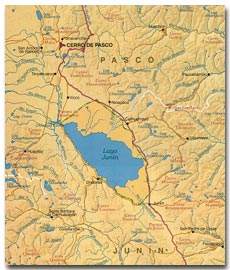
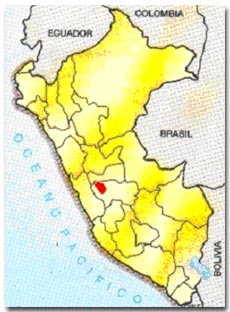
Map: Atlas Departamental del Perú
ParksWatch-Peru, June 2004
By: Inés Vera
________________
Notas
1 Law 27642 \”Reserva Nacional de Junín en Estado de Emergencia\”, 2002.
2 Master\’s Thesis, \”Contaminación por Metales Pesados en Agua Sedimento y Biota del Lago Junín\”, by Ing. Juan Castillo Paredes of the National University of Trujillo in 2001.
3 Law Nº 004-94-EM/DGAA, legal regulations written to provide guidance for monitoring water and air by metal mining activities.
4 Executive Summary, Plan de Gestión Ambiental Sostenible Chinchaycocha. (Chinchaycocha Sustainable Management Plan)