
On March 5, a forest fire on the southern slope of Avila National Park caused a blackout for more than 70% of the city of Caracas and its surrounding areas. The incident occurred because the transmission lines found within the park overheated and activated the automatic security mechanism of the generating plant (found on the northern slope of Avila, in the state of Vargas). As a result, the flow of electricity was interrupted for about 40 minutes (starting at 1:30 pm) for more than 70% of the capital\’s territory. This caused panic among some residents, who were caught off guard by blank traffic lights, stalled elevators and other non-functioning services.
Because of the incident, local officials approved the Public Ministry\’s request to restrict admission to El Avila National Park as a way to both protect the park and the thousands of daily visitors from the potential danger of becoming trapped by a forest fire. From now until June 15 park admission from all access points is limited. The measure orders the National Guard to occupy the park entrances in order to inspect visitors and retain substances or materials that could cause a forest fire.
During last year\’s dry spell, park access was also restricted as a preventative measure. Although this measure could be useful to protect residents, ParksWatch-Venezuela believes that it is not sufficient to remedy the problem of forest fires in El Avila National Park.
Introduction of grasses and other exotic species during the last century has modified the park\’s original ecological dynamics. Periodic fires on the south slope are part of a natural cycle of a savannah ecosystem that now dominates the slope. Underbrush can accumulate in areas unburned during one year, leading to more intense, destructive fires that spread into the forest in the following years. In order to resolve this problem, a special management plan needs to be designed based on a rigorous scientific study, conducted with the support of universities and Venezuelan research institutes.
Loss of electrical service in the country\’s capital has brought to many people\’s attention the greater problem of forest fires and possible solutions. Through this, people who may not have considered themselves beneficiaries of El Avila, because they thought that the park only offered recreational opportunities, have now seen how the park can directly affect them.
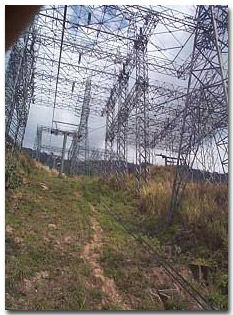
Electricity towers, which distribute electrical energy to the valley of Caracas and its surrounding areas, are located inside El Avila on the lower part of the south slope. The area is mostly covered by grasses and is affected yearly by forest fires.
Photo: César Aponte.
(Top Photo: Each year, forest fires affect the forested areas on the southern slope and they are turning into thick shrubby savannahs. Photo: From the archives of the newspaper \”Últimas Noticias.\”)
ParksWatch: March 2003