
(Photo: Varum Swami)
A few years ago in Argentina, a popular television hostess interviewed a group of paleontologists who had discovered a dinosaur in the Patagonia region. The interview became very popular and was aired several times, not solely for the discovery itself, because dinosaur remains in that region are extremely common, but for the hostess’ exaggerated enthusiasm and comments such as: “You found a dinosaur….alive?” The scientists’ laughter was echoed by the nation’s.
Now, imagine a future television program where paleontologists announce the discovery of a jaguar (Panthera onca) in the Argentine Misionera forest (Atlantic forest) and this same hostess asking the same question: “Are you sure…alive?,” followed by the same general laughter.
According to the last census prepared by the CONICET and the Argentine Wildlife Animals Foundation’s scientists presented at Puerto Iguazú, such extinction seems to be not far from reality due to the alarming reduction in the number of jaguars in the Misionera Forest. Researchers Mario Di Bitteti, Agustín Paviolo, and Carlos de Angelo performed a two-year field study which concluded that the jaguar’s population has been reduced by five or six times in the past 15 years in relation to the density catalogued by the Brazilian researcher, Peter Crashaw, in the 1990s. Currently, there is a total population of 50 individuals surviving in the forest patches located in the Misionera Forest’s green corridor to Iguaçu National Park in Brazil(1).
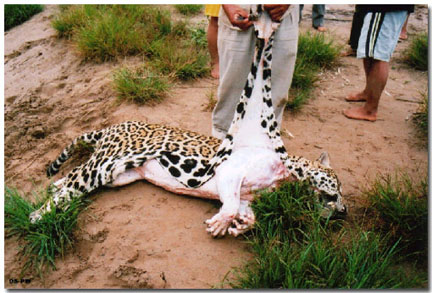
Jaguar hunted and skinned in the Peruvian Amazon (Photo: Diego Shoobridge, ParksWatch Peru)
If we think about the possible causes of this condition, one of the first that comes to mind is the lack of sufficient habitat; this is the most common cause attributed to the extinction of big mammals in the world’s archipelagos, and also in cases of isolation of previously continuous habitats, causes abundantly documented in conservation literature. In addition, the slow loss of natural environments for the nourishment and reproduction of big carnivores is attributed to the lack of protected areas or the lack of connectivity among them.
If we concur that this hypothesis is one of the main reasons(2) and observe in the next satellite image the density of protected areas (PAs) in the Argentine Misionera forest (national PAs in green and state PAs in red) and the detail about forest cover on the right, the jaguar’s situation becomes even more alarming.
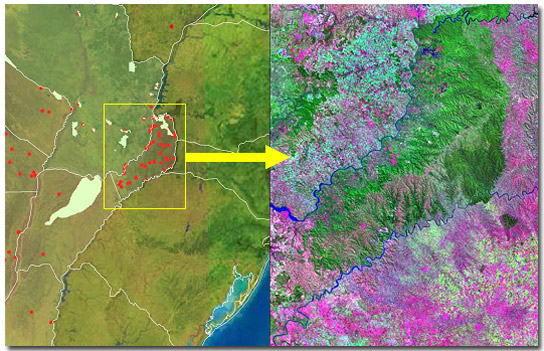
Photo-composition by Jorge Marquez (IANR-ParksWatch) over LANDSAT TM images provided by CONAE
What is alarming is that in spite of an enormous national and state effort to increase the size of conservation areas, with an extraordinary concentration of natural reserves in the so called Corredor Verde de la Selva Paranaense (Misionera Forest Green Corridor), the solution is not producing results when it comes to providing environments for the conservation of big mammals such as the jaguar. There is no doubt that these areas are needed, given that the remaining jaguars use as refuges—at least—the following protected areas: Iguaçu National Park, Urugua-í Provincial Park, Esmeralda Provincial Park, Yabotí Biosphere Reserve(3
), and Do Iguaçu National Park. It is also a fact that there are not enough protected areas, because the jaguar’s population has declined in the past few years. At the same time, models by Gary Belovsky(4) and other authors have warned about the vast conservation area that would be needed for efficient protection, the size of a continent, an area similar to the big mammals’ natural distribution range (5
).
Various questions arise from these facts: What is failing? What should be done? Is it reasonable to ask the Misiones Province to increase the conservation area instead of assigning them to production for human purposes?(6) Is a natural reserve system efficient for maintaining viable populations of large mammals?
One of the faults seems to be the lack of corridor connectivity required by the jaguars. Outside the protected areas, most of the land is occupied by farming, live-stock farms, and forest plantations. The other problem lays in the residents’ animosity towards a dangerous predator such as the jaguar. If currently a few jaguars are the reason for strong controversies between conservation and production, it is likely–as Rubén Barquez suggests–“that a population of, say, 500 jaguars, would bring into action more than one hunter”(7). Because jaguars don’t recognize the boundaries of the jurisdiction that protects them, each time they get out of the reserves they become vulnerable to being shot by residents whose actions are lawfully protected by claiming “self-defense.” This is happening all over the Neotropics. Di Betteti says the effects are multiplied as habitat isolation decreases the number of available prey within the reserves, and jaguars are forced to venture further out in search for food.
The jaguar is not listed in the IUCN’s (2004) Red Book, probably because of their abundance in the South American Continent, but the situation affecting this flag species of the Argentine jungles is completely different. The lack of recognition to its vulnerability is promoting its disappearance from the country’s fauna(8). Ricardo Ojeda calculates that the jaguar’s distribution in Argentina has retreated almost 1,000 kilometers in the past 100 years (subspecies Panthera onca palustris, type locality Luján, Buenos Aires Province); this means a total retreat of 10 kilometers per year! In addition, Carlos Galliari states that 200 years ago the jaguar used to range from the southern United States to the northern Argentine Patagonia, and that beginning in 1900 a steep population decline began, and is currently experiencing a loss of 60 percent of its geographical distribution(9
).
Possible Actions
The above facts show that besides the increase of areas set aside for conservation through reserves and corridors, there is a need for strong intervention in managing big vertebrates—using all available technology—if our goal is to delay the process of extinction. Our planet is rapidly deteriorating and it is too late to leave these animals to their fate, confined to reserve archipelagos surrounded by a hostile sea of human production. They need our help in order to survive.
Agreements among institutions. There are several governmental and non-governmental institutions that are taking actions for the jaguar’s conservation in the Misionera forest: the National Parks Administration (APN), Environmental Brazilian Institute (IBAMA), Argentine Wildlife Foundation (FVSA), the National Council of Scientific and Technical Investigations (CONICET), ESSO Company, the Ecology Renewable Resources and Tourism Ministry of Misiones, and the Yaguareté Network (http://www.jaguares.com.ar) among others. Knowing that the jaguar’s distribution covers several countries and that it forms a compact demogenetic unit in southern Amazon, the agreement of cooperation between Argentina, Brazil(10), Bolivia, Uruguay, Paraguay, and Peru is an essential tool for the decision making process affecting the conservation of this feline conservation in its southern distribution sector. The social agreements and contracts emerging from this debate could lead to the creation of new specific laws for the jaguar’s conservation. The creation of a multi-sector committee embracing different actors is a crucial element for the viability of any project coping with the jaguar’s conservation.
Strengthen the management of strictly protected areas. The fact that the current strategy for the protection of ecosystems where the jaguar lives is not sufficient does not mean that the concept of protected areas has failed. On the contrary, if a small population still survives, it is because they have found refuge within them. It is indispensable that areas categorized as I and II (IUCN’s criteria) carry out the function they were created for; and that sites found to be reproduction habitats for the jaguar be recategorized as strict reserves or critical areas.
Food supply. One of the main problems of the current protected reserve system, is its incapacity to maintain viable populations of big carnivores due to the lack of enough food resources—one of the main reasons that drives jaguars outside their protected area. Maybe this problem could be mitigated with the implementation of a program that supplies food inside their reserves.
Increased connectivity. It is essential to carry out environmental restorations focused on the creation of forest corridors between protected areas. The agreements between forest concessions and the provincial governments could include measures of environmental mitigation which would finance these projects. The construction of corridors through ecosystem restoration should be one of the main priorities for the international financing platform for conservation of the Misionera forest. Some of the restored reserves already exist–such as the one created to mitigate Yacyreta Dam?including large forest plantations with exotic conifers (some of them with more than 600 hectares). These areas should not be counted as natural reserves unless they truly function as environmental mitigators. For that purpose, they should be gradually converted to native plantations.
Managing populations in captivity. One of Gallieri’s recommendations is to manage the stock of zoo jaguars for maintaining genetic variability, minimizing the north-south genetic flow between Amazonian populations(11). This author proposes to create a census of specimens in captivity throughout the Rio de la Plata basin region.
Reintroduction. Although this is a very controversial measure, it is one of the most efficient ways to manage viable populations of big carnivores in numeric decline. There could be a creation of breeding and assisted reproduction centers, using all available technology already used for farming and livestock experiments. Selected specimens captured in private areas could be a part of the foundation population. ParksWatch knows about the Province of Corriente’s plans to reintroduce jaguars to their natural habitat, especially in the Ibera swamp zone. We celebrate these efforts and attitude. For the implementation of this type of solution there has to be more work in changing the laws and regulations, such as CITES, which does not allow wild animals born in natural environments (it does not matter the specimen’s origin) to be transferred from one country to another, effectively preventing reintroductions. Besides this problem, Gallieri says this restriction conspires against the possibility of mixing bloodlines of specimens to maintain genetic variability.
Monitoring individuals. One of the main problems in the conservation of the jaguar is its vulnerability outside protected areas. One way to stop this problem would be to follow all individuals in the Misionera forest (~50) with global positioning systems (GPS), and satellite monitoring. This would allow permanent monitoring and tracking when an individual animal leaves its protected area and enters private property, warning the property’s owner as well as the group in charge of monitoring the population. Establishing an early alert system and a collaborative contract with property owners, the death of these animals could be avoided (at least some of them) by managing their capture with technological support. The work of a collaborative committee, together with the different parties involved in this matter, could carry out the monitoring. In addition to the alert system, this information would generate many data about the jaguar’s habits, movement, corridor use or habitat preference among other. Obviously, this is an expensive and sophisticated solution, not as much in terms of materials, but in the logistics needed to respond efficiently to the alert system’s calls. However, it is probably a small investment if it is compared to the installation costs of much more expensive and complex systems made by our societies to achieve goals of inadmissible frivolity or bellicosity.
Epilogue
A few years ago, in 1991, I was reviewing the list of mammals from the Chicago Field Museum of Natural History, when I surprisingly found out that they have a cranium of Panthera onca from southern Patagonia (Río Chico, Chubut) obtained by the Marshall expedition in 1923 (FMNH 89914). Astonished, I asked the mammals’ curator: So…was it alive? The curator (Bruce Patterson) smiled and responded: “No, of course not! It is fossil material.”
—————————–
By Adrian Monjeau
ParksWatch Southern Cone
Notes:
1) Clarin, October 4, 2005 (Ernesto Azarkevich
misiones@clarin.com)
2) It is Di Bitteti who mentions the lost of natural habitat as a direct cause, adding also the shortage of prey for jaguars as an indirect cause of the same insular effect, as well as the slaughter of jaguars by livestock farmers and hunters.
3) Clarin, October 4, 2005 (Ernesto Azarkevich
misiones@clarin.com)
4) Belovsky, G.E. 1987. Extinction models and mammalian persistence. In: Soule, M. (ed.), Viable Population for Conservation. Cambridge University Press, Cambridge, England. Chapter 3, pp. 35-57.
5) Rapoport, E.H. 1982. Areography. Pergamon Press.
6) Ecology, Renewable Natural Resources and Tourism Minister, Luis Jacob, said the State included in the past year 10.000 hectares to its protected areas system in addition to double the number of park rangers to protect the fauna Clarin, October 4, 2005 (Ernesto Azarkevich
misiones@clarin.com).
7) Taken from a debate of this problem in the SAREM’s (Argentine Society for Mammals Studies) forum
www.sarem.org.
8) Ojeda, R. 1995. Absent without warning? Mastozoologia Neotropical, 2(1):84-85 and SAREM’s forum mentioned above.
9) C.Galleri, in his work “The Yaguareté’s Conservation in the American Southern Cone: What to do with the surviving collection?” He argues that filogeografic studies (Eizirik et al. 2001. Molecular Ecology, 10: 65-79) show that the specie is indivisible and that the population in the south of the Amazon represent a filogenetic compact unity (Galliari is the La Plata’s Zoo Garden’s Director
zoolp@netverk.com.ar).
10) Apolonio Rodrígues, Head of the Conservation and Administration Area of the Iguaçu National Park (Brazil), stated the importance of the two countries in working together for the feline’s conservation (Source Clarin, October 4, 2005 (Ernesto Azarkevich
misiones@clarin.com)).
11) “The institutions with yaguaretés should promote the exchange of specimes for the reproduction of males based on the pedigree registry, as well as to promote the creation of banks of gametes and zygotes. There should be a study of the formulation of inter-institutional agreements for the inclusion of male collections in captivity or peripheral in protected areas, specimens that are sometimes condemned to die due to neighboring settlers.” C.Galleri, in his work “The Yaguareté’s Conservation in the American Southern Cone: What to do with the surviving collection?”