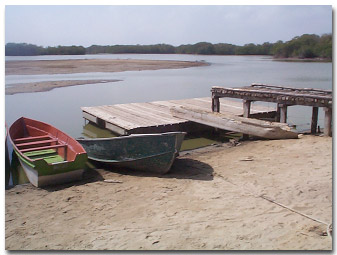
Mangroves in the eastern section of the lagoon. This sector has been the hardest hit by the drought because the Cúpira River that naturally flowed into this part of the lagoon was rerouted futher east during a highway construction years ago. Photo: César Aponte, May 2003.
Laguna de Tacarigua was created to protect an important coastal lagoon. It was also declared a Ramsar wetland site in 1996 because of its biodiversity and because of its particular importance providing natural resources for man (see Ramsar site). Nevertheless, the economic situation of neighboring communities is being affected by the dramatic reduction of fish populations that inhabit this ecosystem.
Various factors are responsible for the extreme drought that has affected the lagoon during the last months including, rerouting of natural flowing rivers that used to provide fresh water to the park, the lack of proper management of lands located in the lagoon\’s basin, and even global climate changes.
Erroneous environmental decisions taken in the past have affected the lagoon. Before, the water of the Cúpira River flowed into the lagoon. But years ago, it was rerouted eastward during the construction of a highway. Another important human modification was the diversion of Guapo River towards the lagoon, which caused a dramatic change in the distribution of sediments. The lagoon\’s depth has been reduced more than 5 meters (more than 16 feet). This leads to increased evaporation, salinity and temperature.
When the water and sediments of the Cúpira River flowed into the eastern section of the lagoon, the accumulation occurred slowly and sediments spread over the entire bed of the lagoon. However, now after the rerouting, the sediments flow almost directly in front of the lagoon\’s mouth, creating more of a permanent-stlye barrier between the lagoon and the sea. Even though being temporarily closed off from the sea is part of this coastal lagoon\’s natural cycle, the frequency that its mouth is closed off, and the time it remains closed off from the sea are both increasing.
The problem of lack of fresh water supply also stems from agriculture and grazing. Both these local land uses consume large amounts of water supplied by the rivers, and now many of the rivers have completely dried up. The water in the lagoon is normally salty, a mix of sea water that enters through the lagoon\’s mouth and the fresh water coming from the rivers and other sources that empty into the lagoon. The reduced contribution of fresh water means increased salinity within the lagoon. Many fish that come to the lagoon to reproduce (including the emblemático lebranche) have died because they are intolerant to these higher salt levels. So many have died that the lebranche fish sold in the fish markets near Tacarigua has to be brought in from other regions of the country.
Nevertheless, there are solutions that could help to improve this situation. Any solution needs to examine the roots of the problem. First, ParksWatch-Venezuela recommends a studying the lagoon\’s water and sediment flows to determine how effective restoring the natural flow of fresh water might be in solving the problem of lack of water. Also, limiting different land uses, and to the extent possible, regulating the water consumed by these land uses would be solutions. Agricultural activities, such as planting cacao, should be favored because it is a money-making crop, it is tied to the region\’s culture already and it is environmentally friendly.