
The Minister of Popular Economy, Elías Jaua, announced in March that his office will carry out endogenous development projects in various national parks in the country. These projects will form part of a policy governing environmental preservation and adequate resource use. Likewise, he emphasized that endogenous development will be advanced in Guatopo National Park, as well as in all the places where families responsible for promoting these programs live.
The Galipán community, located within Ávila National Park, is one of the first parks to benefit from the creation of an Endogenous Developmental Center. The Minister of the Environment, Jacqueline Faría, recently visited the park to better understand the area were the center will be located.
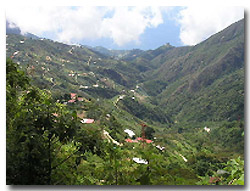
Indigenous populations in Galipán, Ávila National Park (photo © César Aponte)
Thanks to the community\’s strong organization, characterized by its Communal Council of Planning, FIDES assigned 2.3 million for the creation and development of this project, which will benefit the tourist and agricultural development of the population in the national park. The \”Integral Endogenous Development Project of Galipán\” encompasses 26.5 hectares in five sectors: San Antonio, San Isidro, San Francisco, San José, and Manzanares, which constitute the area for the Agricultural Plan. Under this plan, 60 families will benefit by carrying out cultivation of indigenous flowers, peaches, and other fruits. They will obtain technical assistance from the Central University of Venezuela in the use of leaf fertilizers and biological pest controls. With the participation of five cooperatives (transportation, tourism, ecotourism, education, and agriculture) the project implies the creation of two hotels, a restaurant, and a social center with many uses.
The implementation of these endogenous developments in the national parks represents a radical change in the management policy of protected areas in Venezuela. Recently the National Institute of Parks (INPARQUES) created the Office of Community Attention and Endogenous Development (OACDE). Currently the office runs a workshop for INPARQUES personnel, in order to train them to train the parks\’ inhabitants in organizing and promoting these centers. Before initiating an Endogenous Development Center, an environmental impact study (EIA) is conducted on the areas in which the plan would be carried out. In addition, all activities will be carried out in accordance with the Management Plan and Use Regulations
Nevertheless, the announcement of this new policy has generated reactions from the diverse environmental agencies in Venezuela. Diego Díaz Martín, executive director of Vitalis, expressed his feeling that \”the national parks have not been created for agribusiness; thus, agriculture, including the cultivation of flowers, should only be carried out in those areas of special use that existed before this plan, with very clear rules to avoid intensification and expansion [of this agriculture].\”
On the other hand, José Moya from the Federation of Organizations and Environmentalist Boards (FORJA), does not understand the Minister of Popular Economy\’s objective. He considers the endogenous center as a threat to the vital ecosystems inside the national parks. In addition, he remembers the landslide that occurred in Vargas State in 1999, and believes the project ought to include the stabilization of mountain slopes affected by this tragedy.
In the case of endogenous development in La Elvira, within Guatopo National Park, environmentalist groups from Altagracia de Orituco denounced the proposal, saying it would deforest the land in order to cultivate coffee, and they found many cedar trees already marked for removal. They indicated that thanks to intervention from the Mayor of Altagracia of Orituco and INPARQUES\’ officials, the project was modified to focus on tourism. They add that the government should focus its efforts to promote endogenous development in the nearby town of San Francisco of Macaira, considered a lost jewel in the guariqueño piedmont.
It\’s important to mention that not every community that inhabits a national park can remain within its boundaries. The current law states that only populations that have been in existence for more than 50 years and are characterized by \”a social, economic, and cultural way of living that in and of itself constitutes an environmental improvement factor\” can remain within the protected area. Any population engaged in activities that do not adhere to these requirements should be relocated and should not benefit financially from the development of endogenous development centers.
Besides the environmental impact study (EIA), each endogenous development center should be preceded by the approval of a Special Site Plan. This is the most appropriate planning instrument to execute activities of this type inside a protected area, because it will identify the potentials and limitations of the land. Nevertheless, it is not sufficient to carry out these studies solely on paper; it is necessary to verify that the recommendations and rules established by these documents are actually complied with, in order to avoid or reduce negative impacts on the ecosystems.
It is of vital importance that the Venezuelan government allocates a better budget for the administration and management of the national parks\’ system. These protected areas are experiencing the effects of various threats caused by human activities (deforestation, forest fires, illegal extraction of flora and fauna, pollution) that are preventing adequate compliance with those objectives for which they were originally created: conservation of hydrographic basins and biodiversity.
The system of national parks in Venezuela is an indispensable element for the country\’s agricultural development thanks to the environmental services it provides: protection of hydrographic watersheds, climate regulation, and control of the runoff and erosion. True sustainable development should take into account not only sustainable use, but also a more active conservation policy for the environment and biodiversity.
ParksWatch – Venezuela, April 2005