
Sustainable development is development that meets the needs of the people today without compromising the ability of future generations to meet their own needs. Some communities inhabiting dry forests in Peru have experience with this type of development and they are aware that if the want to continue to rely on their natural resources, they should not degrade them. The Research and Integrated Development Association (AIDER) carried out a sustainable development project in the rural community of José Ignacio Távara Pasapera de Piura, which is home to 74 poor families. For the community members, the experience changed their lives. Now, they work with the resources of the dry forest instead of against them. They have also developed a culture of conservation and a better quality of life. Other communities living around the Northeastern Biosphere Reserve could benefit from positive results such as these if projects aiming to reduce pressure on the forest could help them apply the same sustainable development strategies.
Peru\’s dry forests are found throughout Lambayeque Department in the north. These dry forests are noteworthy because of their ecological characteristics and high density of vegetation. Yet, because of human activities in and around the reserve, these forests are being degraded and deforested.
According to the National Resource Institute, INRENA, this irrational use has been and continues to be a constant problem in most of the Northeastern Biosphere Reserve. INRENA states that in most cases, forestry activities in the region are unsustainable, operate without management plans, and continue to expand. There are many places where only remnant forest patches remain; there are even areas that have been logged entirely. On top of this forestry pressure, are unsustainable livestock ranching practices, which include overgrazing and burning pasturelands. The overwhelming trend in the area is therefore towards desertification and complete loss of the forest resources (1).
Residents of dry forests are confronted by daily hardships to find food, energy sources, and homes. In order to survive, and in desperation, they indiscriminately log the forest, overgraze pastures, and expand agricultural lands without regard for the environment or long-term consequences of their actions. According to AIDER, these activities are carried out many times in inefficient ways and do not actually help the communities to emerge from the poverty in which they live. AIDER emphasizes that in fact, the opposite occurs because the communities become predators of the forest resources. Because of the ecosystem\’s fragile nature, these activities can lead to desertification (2). By eliminating the vegetative cover, human activity is contributing to erosive processes that will eventually turn the dry forests into dunes without natural resources.
The experience of the rural community José Ignacio Távara Pasapera
In 1996, AIDER worked on a participatory integrated management project with the community of José Ignacio Távara Pasapera, in the department of Piura. The AIDER association was dedicated to bettering the community\’s quality of life and saving the ecosystem. Their primary goal was to reorganize the economic activities in order to obtain income based on sustainable development. To do this, they had to put an environmental education program into place in order to raise a conservation consciousness.
AIDER also implemented forestry management plans and silvopasture techniques. The first step was to create management committees with responsible directives and active members. The local vision of development employed during this project was that the forests and residents should be given equal attention. The forestry management plan aimed to restore degraded and deforested areas.
Once the dry forest responded positively to this management style, project participants started to collect algarroba fruits from the algarroba (Prosopis pallida) tree. This is a valuable dry forest resource. According to the well-known expert, Dr. Antonio Brack Egg, \”it possesses an extremely high nutritional value, unrivaled throughout the world.\”
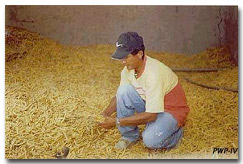
Algarroba is collected and then stored in small adobe huts, built by the community (photo: Inés Vera)
Algarrobina, which is produced by boiling the fruit, is a typical Peruvian food that contains minerals and sugars important in the human diet. Another product is algarroba flour, an essential ingredient for livestock feed. Because of these important qualities, Brack argues that standing and producing algarrobo trees are much more valuable than logged algarrobo used for making charcoal.
AIDER\’s experience created a new model for earning a living-by selling algarroba fruits and its derived products. It also introduced storage technologies and the community built storage facilities essential for their livestock during the dry season and during times of scarcity.
Another economic activity that the community adopted, with the help of AIDER, was silvopasture. Engineer, Vicente Merino, comments that the long standing belief is that the sheep and goats destroy the forest, but he emphasizes in reality, people are the ones who do not know how to control the livestock activity so that it does not destroy the forest. Therefore, by determining a sustainable use of pasture and grasslands, AIDER and the community developed a silvopasture strategy.
The first step in creating the strategy was to conduct a livestock diagnostic using rural participatory appraisal and conduct territorial planning in which they could study the productive capacity per hectare of the pastureland. In addition, they established vaccination dates, veterinarian medicinal kits, and a rotating community fund for livestock. In addition, the beneficiaries received technical assistance and capacity-building workshops. A well-developed and well-run silvopasture system allows for forest regeneration.
Finally, these changes produced results. The grazing/livestock raising system went from extensive to semi-extensive. This allowed for controlled grazing and for rotating pasturelands. They learned that the forest provides alternative nutrition sources that could save their livestock in times of scarcity. Overall, the project\’s greatest achievement was creating a collective awareness about forest resource management to benefit the community and livestock.
This sustainable development challenge was met by the rural community José Ignacio Távara in the year 2000. Since then, AIDER has left the use of the forest\’s natural resources completely under the community\’s control. The families involved in the project now enjoy a better quality of life because of the aggregated value of their products. Family diet has improved, and poverty has lessened. Now, the goal is to expand the experience and knowledge to other communities.
Communities near the Northeastern Biosphere Reserve that face similar problems as the José Ignacio Távara community could learn from their successful experience with sustainable development, not only to improve their own lives but to also help protect this high-priority conservation zone. Dry forest ecosystems are fragile, and it is a race against the clock to save remaining fragments. The resources of the Northeastern Biosphere Reserve should be conserved to benefit nearby communities and biodiversity.
ParksWatch-Peru: November 2003
By: Inés Vera
_____
Note:
1 Instituo Nacional de Recursos Naturales, INRENA Tumbes, Perú. June, 2001
2 AIDER \”Recuperación y Producción Sostenida de Bosques y Praderas, un Medio de Lucha contra la Desertificación y la Pobreza\” Lima: AIDER. Lima, 2001