
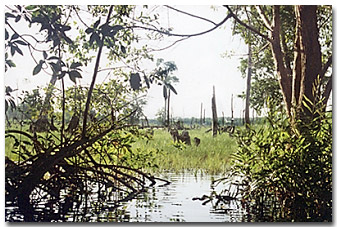
Wetlands of Pantanos de Centla Biosphere Reserve, photo credits: J.C.G. Bravo.
A great variety of estuarine, highly productive, coastal ecosystems teaming with biodiversity is found along Mexico\’s 11,000 km of coastline. The most predominant ecosystem types are coastal lagoons and the mangrove systems. In addition, freshwater wetlands are found along the coast. Fishing and harvesting seafood are economic activities carried out in coastal wetlands.
Mangrove ecosystems are some of the most important because of their ecological, economical, and cultural values. For example, they maintain high levels of biodiversity (both flora and fauna), they store and purify large quantity of water, they retain nutrients, protect the coastline, help regulate the climate, and they are important nurseries for economically important species of fish, shrimp and crabs.

A bare-throated tiger heron (Tigrisoma mexicanum) in the wetlands of Pantanos de Centla Biosphere Reserve. Photo credits: J.C.G. Bravo.
Some of the important wetland sites in Mexico are:
La Laguna de Alvarado in Veracruz;
Los Pantanos de Centla in Tabasco;
La Laguna de Términos in Campeche;
Los Petenes in Campeche;
Wetlands of Sian Ka\’an in Quintana Roo; and
Marismas Nacionales in Sinaloa y Nayarit.
Currently, the situation for these species-rich and economically important ecosystems is critical. Every year, between 8 to 15% of the coastal wetlands is converted to other land uses. The four most prevalent reasons for destroying the mangroves are:
* For agricultural purposes;
* For tourist development;
* To establish man-made lagoons for shrimp farming;
* To use the wood.
Mangrove trees of Laguna de Términos Biosphere Reserve were destroyed for agriculture. Photo credits: Gerardo Carreon.
It is obvious that ecosystems such as coastal lagoons and mangroves are altered because of the growing population, because of industrial pollution (such as the case in Laguna de Terminos and Pantanos de Centlas that are contaminated by PEMEX), by large-scale development projects for tourism (like in Cancun and Sian Ka an), and by the growing shrimp industry that deforests, contaminates, and causes salinization of agricultural lands and of the ground water.
In order to overcome these threats, civil organizations, the government, and local communities must work together to minimize the pressures on these fragile ecosystems. The Mexican government has taken steps to protect these wetlands. They have put forth a proposal to incorporate six coastal areas containing coral reefs into the RAMSAR Convention. The areas are: Banco Chinchorro Biosphere Reserve, Reefs of Puerto Morales National Park, Huatulco National Park, El Vizcaíno Biosphere Reserve, Sian Ka\’an Biosphere Reserve, and Ría Celestún Biosphere Reserve. If the proposal is accepted, Mexico will have a total of 13 RAMSAR sites.
ParksWatch – Mexico: July, 2003