
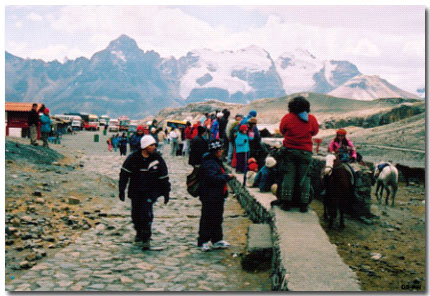
Concentration of buses, cars, and other toursit transit vehicles.
Tourism is one of the most important development activities in Peru, and Huascarán National Park offers many opportunities for tourism. There are diverse alternatives in the park like ecotourism (ecological tourism), experiential tourism, adventure tourism, mountaineering, mystic and cultural tourism, among others. In order to avoid damaging effects and curb tourism’s negative influences on the natural and social environment, operators must obey the environmental impact studies that determined permitted access routes and norms of conduct, which were developed to better manage and control visitors.
Unfortunately, management is not effectively carried out and innumerable informal tourism operators utilize unauthorized routes to enter the park and ignore established conservation regulations. The number of park guards employed by the National Institute of Natural Resources (INRENA) is insufficient to control such a large area, and according to some official guides, the guards fail to impose their authority over informal operators.
Unlike Machu Pichu Historic Sanctuary, that has four permanently controlled access routes, Huascarán National Park has more than forty access routes that include landing strips, hiking trails, and roads suitable for vehicular passage, which makes controlling tourism traffic in the entire area practically impossible.
Making matters worse is a serious conflict between the park and some rural communities, who compete for administration of the protected area’s tourism resources. This is the case with the rural community Cátac, which is found along the way to Pasturui, an extremely important tourism destination in the region. This community has been in litigation with the Peruvian Government for more than two years. They allege that “this is their stream and no one has the right to use a resource that belongs to them.” This point of view could be understood, but the consequences could unleash a multiplier effect in other communities who could start charging for access to the park in their corresponding sector, creating more conflicts for the park’s administrative system. On one hand, the communities are not sufficiently prepared to carry out proper administrative management of tourism resources and on the other hand, the park’s current administration would lose out on income, which would affect the functioning of this park as well as the entire National System of Natural Protected Areas.
Some communities block their streams and charge whoever needs to travel through there, making tourists uncomfortable. Tourists have to pay “tolls” established by rural communities and pasture-user committees, which have become an informal regulating entity that will not let anyone pass unless they pay the toll, even if they have an entrance ticket issued by the Park’s administration, INRENA, or anyone else.
Horse rental to tourists in Pastoruri.
There are NGOs related to special interest and politically powerful groups that have bypassed INRENA to carry out their operations. They have built mountain retreats along different streams within the park and started their activities according to their own principals—which not only generated conflicts with neighboring communities, but also with tourism operators. The retreats generate environmental problems in the park, and according to members of the Casa de Guías de Huaraz (Huaraz Guide Guild), no control is carried out regarding environmental protection in these installations.
The problem is further complicated when one considers the implications for other tourism operators. The infrastructure was initially supposed to consist of “mountain retreats,” that is, places where mountain climbers could stay the night during their hike along the snow-capped range. However, the retreats are no longer just lodging climbers, they now offer food and drink at exorbitant prices, provide gear hauling services, and rent cargo animals, cooks, and mountain guides. This has created a serious problem since a large number of people who made a living by offering these services for years, and who belonged to legal, long-established tourism guide guilds, are now without jobs. In Huaraz and many other communities along access routes, people whose work has been affected by the appearance of this type of competition are not happy, as it seems that the competition is trying to monopolize mountain tourism services in Huascarán National Park.
According to César Moreno Huerta, President of the Chamber of Tourism of Huaraz, the NGO Matogrosso, plans to build a mountain retreat at the base of Alpamayo snow-capped peak under the name, “Glacier Control and Monitoring Center,” which would be part of their strategy to continue to expand their presence and tourism offerings. Competition is normally a good thing, but in this case, there is an evident imbalance because the NGO has political support helping it achieve its mission of commercial expansion.
It should be noted that the situation in Huascarán National Park is not unique; most national parks in Peru have similar problems. Campaigns promoting a “tourist culture” should be generated at the national level, and actions and strategies should be implemented that not only take responsibility for promoting tourism in our country [Peru], but that also establish and enforce laws and regulations for tourism administration and proper environmental management directed at the principal tourism stakeholders.
By: Guido Vidal Stiegler
ParksWatch – Peru: October 2005