
Photo: A. Tello (Viajeros Magazine)
\r\n\r\n
Even though Peru has a vast marine territory, it only has one marine protected area. Paracas National Reserve is the only conservation zone for endemic species and other coastal/marine species. Yet, all along the Pacific Coast, there are bays, islands, and inlets where marine species, some endangered due to over harvesting and contamination, live. One such place is the San Fernando Peninsula, which lies 470 km south of Lima, in the district of San Juan de Marcona, department of Ica.
\r\n\r\n
San Fernando\’s Riches\r\n\r\n
Three types of ecosystems converge in the San Fernando Peninsula: the ocean, the desert, and the coastal hills. In this zone, diverse species of these different ecosystems connect through food chain interaction. For example, when South American sea lions (Otaria byronia) and the South American fur seals (Arctocephalus australis) give birth, Andean condors (Vultur gryphus) can been seen flying above the peninsula looking to feed on the placentas seen below. Arctocephalus australis is considered an endangered species and Otaria byronia and Vultur gryphus are considered species in vulnerable situations (INRENA S.D. Number 013-99-AG, 1999), yet they inhabit San Fernando where they manage to maintain equilibrium. \r\n\r\n
The San Fernando Peninsula has a peculiar geography that allows for condensation and humidity in its higher elevations while desert dominates the coastal area. Fog coming from the ocean crosses the desert and then reaches the arid hills where it is stopped and condenses. This phenomenon is a source of life for the guanacos (Lama guanicoe), which during the green season migrate from the highlands to the edge of the Aguada Beach to drink the filtrations of fresh water flowing into the ocean. This Andean member of the camelid family is a threatened species and San Fernando is one of the few refuges in Peru that remains for this species when it migrates from the highlands. \r\n\r\n
Along the peninsula\’s coastal desert and ocean live a great number and variety of Peru\’s shellfish, fish, birds, and marine mammals. The region\’s abundant ichthyofauna attracts many fishermen. Commercially important species include anchoveta (Engraulis ringens), corvina (Cilus gilberti), silverside (Odontesthes regia) and flounder (Paralichthys orbignyanus). There are also large numbers of endemic, common resident, and migratory birds that nest between the rocky cliffs. For example, there are red-legged cormorants (Phalacrocorax gaimardi), guanay cormorants (Phalacrocorax bougainvillea), Peruvian pelicans (Pelecanus thagus), turkey vultures (Cathartes aura), Inca terns (Larosterna inca) and surf cinclodes (Cinclodes taczanowskii). The seals and Humboldt penguin (Spheniscus humboldti), endemic to Peru along the Humboldt Current, live on the islands and beaches of the zone. Humboldt penguin is considered an endangered species. \r\n\r\n
Characteristic Threats\r\n\r\n
Fishing and mining are the principal economic activities for the district of San Juan de Marcona, where San Fernando Peninsula is located. Both activities have caused environmental impacts in the zone. Over fishing has lead to a reduction in densities of some of the sought after species while mining has been a more complex, socio-environmental problem.\r\n\r\n
Shougang Hierro Perú SA exploits the largest iron deposit in all of Peru and it dumps its mining tailings into the ocean. The company is located south of San Fernando and since 2002, it has closed 19 of its 20 ducts in San Nicolas Point. Mr. Juan Carrasco, a biologist from the area has been researching the contamination effects from mining in the peninsula over the last three years. He completed an exhaustive study that found, \”a high concentration of iron, lead, cadmium and manganese in marine species like the snail, silverside, and Peruvian rock seabass, which are consumed by humans and are sold in the markets of Lima.\” In addition, the study finds, \”these heavy metals, that are highly toxic (because they remain in the human body) and are found in concentrations higher than the permissible limits established by the European Union.\” (1) \r\n\r\n
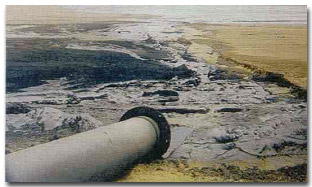
Photo: J. Carrasco\r\n\r\n
Contamination from mining in San Nicolas has directly impacted the San Fernando Peninsula because the ocean current travels from south (San Nicolas) to north (San Fernando) and deposits these contaminating agents in the region of the peninsula. This has contributed to the decline of species such as the red-legged cormorant, the Humboldt penguin and the guanaco.(2)\r\n\r\n
New Threats\r\n\r\n
In July of 2003, the Ica Regional Government declared the San Fernando Peninsula a natural reserved zone under Law Number 07437. Despite this declaration, in the same month, a consortium known as \”Nazca Ecológica\” bought at a public auction held by the Ministry of Agriculture, through the Private Investment Promotion Agency (ProInversión), 498 hectares of San Fernando Peninsula. The approved law declaring the area a natural reserved zone came into force 90 days later. \r\n\r\n
The Nazca Ecológica Consortium plans to invest a quarter million dollars to build an ecotourist complex. This year, they began building the road to access their land; however, the local population and local authorities opposed. The President of the Ica Region, Vicente Tello, rose up and paralyzed the work. He has demanded that the purchase be nullified and the entire area considered a national reserve. In addition, he is working to stop the legal process of the documentation declaring the consortium as the owner, which always them to build on \”their\” land. \r\n\r\n
Locally, people are organizing environmental awareness conferences. The nearby communities are meeting with fishing and shellfish associations, tourism companies, environmentalists, and other organizations involved with different environmental problems (like those involved with Camisea gas and the logging of Prosopis pallida) working in the same region. They hope to discuss the ecological value of their natural resources. The participants have declared a coordinated and organized fight in order to conserve the zone and stop further ecosystem deterioration.\r\n\r\n
ParksWatch – Peru, June 2004\r\n\r\n
By: Inés Vera\r\n\r\n
Notes
______________________\r\n
1 Rocha, Álvaro. \”Un Milagro para San Fernando\” in: Revista Somos, May 29, 2004. Lima, pp. 24-29.
2 Cartagena, Ana. \”Receta para salvar San Fernando\” in: Revista Viajeros Año 2 N° 9. Lima, pp. 11-22.