
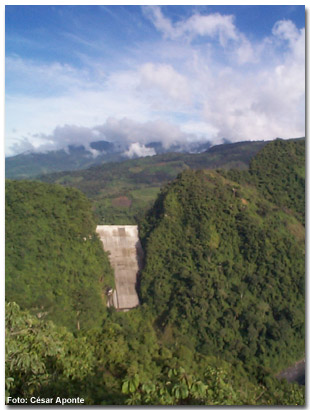
Yacambú\’s cloud forests produce and capture the water that feeds into José María Ochoa Pilé Reservoir.
Yacambú National Park is a vast mountainous refuge of cloud forests found north of the Andes and south of Quibor Valley in Lara State. Several endangered species live in Yacambú, such as the spectacled bear (Tremarctos ornatus), the only bear species in South America, and the helmeted curassow (Pauxi pauxi), one of the most threatened birds in the world.
In addition to the ecological benefits provided by the park, Yacambú, like the rest of Venezuela\’s National Parks, is an essential part of the country\’s economic and social development. In Venezuela, 85% of the water consumed by humans or used in industry, including the country\’s electricity-producing industries, comes from the national parks. This is true in Yacambú as well. The water from the park drains into Yacambú River, which feeds the José María Ochoa Pilé reservoir. This dam project is a multimillion-dollar investment with more than 30 years of work. It is considered an important strategy for the development of the Lara State and for the entire country.
Once completed, the reservoir will provide water to the city of Barquisimeto ( with 800,000 inhabitants), and will provide water to irrigate approximately 25,000 hectares in Quibor Valley. This valley is part of an arid zone that already produces important agricultural goods, like fruits and vegetables, which have high economic value in both the national and international market. According to official estimates, by increasing the amount of productive land through irrigation, Quibor Valley will be able to produce 688,000 tons of crops per year compared to the 85,000 tons currently produced.
This implies a significant increase in the number of jobs available in the region, from the current 3,900 jobs to 19,000 jobs (a 488% increase). Projections suggest that the value of this increased agricultural production is 327 million dollars per year. To give an idea of the importance of this project for the country\’s development plans, for 2004, the Venezuelan government has budgeted another 91 million dollars to continue the dam\’s construction. The project\’s viability completely depends on legally protecting its watershed. Appreciative of this fact, the state-owned company, in cooperation with the National Institute of Parks (Inparques), decided to increase the protected area\’s surface by more than 80% in 1999.
Nevertheless, the efforts to conserve the watershed and the state\’s investment to complete this project could be seriously hampered by recent invasions into the park. Sixty families have invaded more than 200 hectares throughout Yacambú National Park. During our evaluation in July 2003, ParksWatch documented at least 25 small farmers with five hectares each settled along the road in the park that goes to the dam. According to park guards, the majority of those small farms are less than three years old.
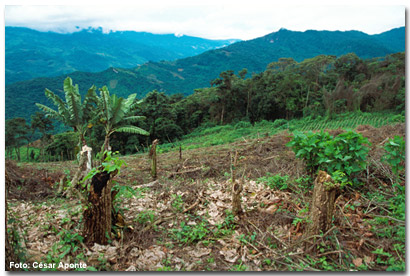
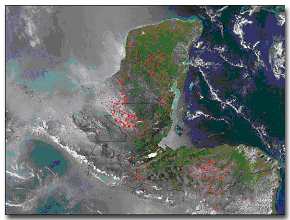
Most of the farmers grow vegetables, which require agrochemicals harmful to the natural environment and large deforested areas to grow. Another direct consequence of the invasions is the increase in forest fires. During the last two years, there has been a notable increase in forest fires, which have caused serious damage to the park.
According to the Environmental Penal Code, which has been in effect in Venezuela since 1992, occupying territory within protected areas and using protected area land in ways that are incompatible with the established norms are serious crimes that could result in prison time for the perpetrator(s). Nonetheless, the authorities rarely pay attention to these types of offenses. That is why it is essential to raise awareness regarding the ecological and economic damages these invasions cause.
Deforestation, forest fires, increased soil erosion and contamination all threaten to destroy the forest and its ability to provide water. This in turn threatens the functionality of José Maria Ochoa Pilé dam, which would mean a complete waste of a large financial investment and would be an obstacle to the country\’s overall economic and social development, especially in the agriculture sector.
The invasion problem is complex and must be dealt with in a diplomatic way to avoid human rights\’ violations, but at the same time to stop the continual violation of the Environmental Penal Code.
ParksWatch-Venezuela: November, 2003