
Paracas National Reserve, the only protected area for the conservation of marine biodiversity in Peru, is faced with the construction of an industrial plant, a project of Gas de Camisea de Pluspetrol, in its buffer zone. The NGOs involved with this reserve and the local populations of Pisco, San Andrés and Paracas have publicly protested in order to impede the Argentine business from completing the plans. According to the Coastal Areas and Marine Resources organization (ACOREMA), this project, still in the development stages, threatens the coastal habitat for all the species living in the bay and the local population. However, Julio Reyes, a marine animal specialist, project coordinator and spokesman for Camisea from ACOREMA, affirms that Pluspetrol has managed to convince all those who thought the corporation\’s intentions were not favorable and as for the reluctant few, they removed them from their way.(1)
The energy partnership, formed with Pluspetrol Corporation at the top, with Hunt Oil from Texas, as well as Halliburton\’s Kellog Brown and Root , possesses a license to extract Camisea\’s gas resource for 40 years. This industrial development project includes production, processing, transport, and distribution of the gas. This implies the construction of plants and an international network of pipelines that will cross the Selva and Sierra del Peru (forests, native communities, rivers, mountains, protected areas) to the ocean to load the product for shipping. The proposed fractioning plant, on the Paracas National Reserve\’s Lobería Beach, is only part of the infrastructure that will be built in Peru.
The corporation purchased 260 hectares for $800, 000 dollars(2) in Paracas National Reserve\’s buffer zone (Lobería Beach), thanks to a Paracas Municipal decree that converted this part of the zone for industrial use. For Pluspetrol, acquiring this property signified great savings, for now gas exportation is reduced to just an infrastructure investment, in terms of harbor installations, etc. The Interamerican Investment Bank (IDB) will finance the total cost of 1.6 million dollars. The nation, thanks to this investment, will have substantial economic growth. For the IDB the project is one of the most significant capital investment programs in the history of Peru.(3) The State supports the project and maintains a public position favoring Pluspetrol. The Minister of Energy and Mines, Jaime Quijandría, ruled out any possibility of contamination in statements to the media.
Parts of the public and some environmentalist groups oppose the construction of the fractioning plant on principle. Facing this pressure, IDBpostponed approving the loan on two separate occasions. However, this did not stop Pluspetrol from contracting with the construction business Graña & Montero in order to not lose any time. The architect, José Granda, a member of the Paracas Bay Sustainable Development Commission, as a representative of the Pisco Municipality criticizes this procedure: They have proceeded assuming things to be fact. The plant was being constructed since before the approval of the loan. No business makes a multi-million dollar investment on an uncertain situation. From the beginning it was legitimated by the government, they were gaining time.(4)
Concurrently with the plant construction, Pluspetrol had invested in acquiring residents\’ approval in Pisco, San Andrés, and Paracas. They are aware that the Paracas National Reserve is a source of tourism. Reyes confirms that Pluspetrol has promised, through meetings and public hearings with the Pisco settlers, 600,000 soles ($173,560) over 40 years to fund environmental education at 250 schools in the province. At first the number seems promising; but in reality it is only 60 soles ($17.36) a year for each school. This will not cover the salary of even one teacher.
For the members of the San Andrés Fisherman, Artisan, and Seafood Collector Association (ASPAEMSA), Pluspetrol has not only promised them that their economic activities are not in danger, but also agreed to give 40, 000 soles ($11,570) to repair and replenish fishing supplies. The ASPAEMSA Secretary General, a member of the Paracas Bay Sustainable Development Commission, Mr. Víctor Manuel Chacaliaza Ramos, speaks about his district: We are working together for San Andrés now. They have always kept communication open with us. The mayor has received work certificates from Pluspetrol and they have already begun paving.(5)
This same type of relationship has been established in Paracas between Mayor Alberto Honorato Tataje Muñoz and the business. In the El Chaco beach tourism area, a seafront walk is being constructed with more than 10 workers a day, seven days a week, using cement, wood, and stone. Visitors from the Ballestas Islands frequent this place, as it is where the boats to the islands leave. In addition, there are numerous restaurants that are improving infrastructure and increasing the amount of services to make the area have the same feel and tone as the new seafront walk. The tourists, after viewing the sea lions, Humboldt penguins, and other species, go to these places to enjoy seafood meals.
Paracas fishermen know the ocean well and know how to read its signs. They support the presence of Pluspetrol in the Bay. They do not protest the plant\’s construction and do not understand why public opinion and environmentalists defend the reserve in this manner.
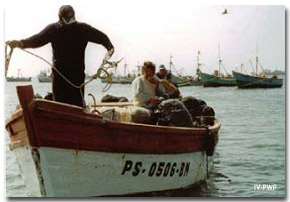
Mario, a fisherman for 30 years, has seen how the flour industries have plagued the coastline. He also witnessed, in the San Martín Port bordering the Paracas National Reserve, how a human error loading sulfuric acid caused the death of sea gulls, pelicans, guanays, and various fish species. For 25 years the San Martín Port has acted as depository for sulfuric acid produced in the Cajamarquilla refinery. The product is taken over land to Pisco, passing through part of Paracas\’ buffer zone to be shipped out.(6) Nowadays the fishermen like Mario are faced with a shortage of marine resources because of the waste produced by the flourmills that damage fish populations. They are only able to harvest seafood near the San Gallán inside the reserve; they can no longer find any other place.
Paracas National Reserve managers have not responded to these situations , nor to the Pluspetrol project. Patricia Saravia, a biologist responsible for the reserve, explains that they are not in a position to give their professional opinions. She said, We depend on IRENA on an institutional level; we only see the management of the area. For political matters we are not authorized to give our position. We may only when they authorize us to do so. Out perception would be a novelty; it would serve nothing.(7) The former head of the reserve, biologist Rafael Tamashiro, resigned due to differences in opinions.
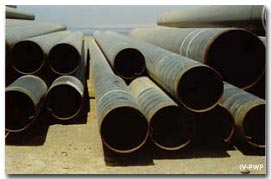
Pluspetrol comes into the reserve from San Martín to Atenas beach, unloading all the pipes necessary to construct a five-kilometer (3.1 mile) underwater pipeline out to sea to an existing platform. The anticorrosive steel pipes have been covered with three polyethylene caps. The pipes measure between 12 and 15 meters (40-50 feet), weigh 4.172 kg (9 lbs), withstand exceptionally high temperatures and the presence of microorganisms. The company that manufactures them, CONFAB BRAZIL, is a world leader in the construction of materials for petrochemicals and pipelines. They are contracted to produce 575 km (357 miles) of pipes that will cover our nation from Cusco to Pisco.
To prevent the potential environmental impacts from Pluspetrol\’s plant, the State has created the Paracas Bay Sustainable Development Commission. Within the scope of its control are the municipality districts San Andrés, Paracas, Pisco and San Clemente, Paracas National Reserve and its buffer zones, and the islands of Chincha, Ballestas, and Isla Blanca. The members are interested persons and responsible institutions that possess environmental experience and knowledge, as well as all the major economic players, and political and social activists involved in this zone. CONAM (the National Cabinet of the Environment), leads the commission. There are also representatives of the central government are also found from the Ministry of Agricultural (INRENA), the Ministry of Foreign Trade and Tourism, the Ministry of Energy and Mines, the Ministry of Production (IMARPE), and the local governments from the Pisco, San Andrés, and Paracas municipalities. They also work with non-government groups such as ASPAEMSA, fishing industrialists, those involved with the Camisea Project and the environmental NGOs. This commission organizes meetings in order to establish their formal structure and work plans. The NGOs do not attend, because, according to ACOREMA, their presence achieves nothing if everything is conducted with the State\’s interests in mind.
For now all that can be done is to wait and see if Pluspetrol keeps its promise to not cause any environmental impact in Paracas and the mechanisms put forth in environmental studies and the environmental management plans are strictly followed. However, it is possible that the natural gas fractioning plant will generate demand for the surrounding lands to build more flourmills, power plants, industries, etc. This is a threat to Paracas\’ ecosystem because it is already fragile and sensitive to human activity.
ParksWatch-Peru: November 2003
By: Inés Vera Pinzas
Notes:
1 \”Pluspetrol ha logrado convencer a todos aquellos que pensaron que las intenciones de esta corporacion no eran ventajosas y a los recientes los han sacado de su camino\”
2 www.ambienteyenergia.com, Web page created by the NGO, El Globo: clean energy, environment, and normalization.
3 \”Uno de los programas de inversiones de capital más significativos en la historia del Perú.\” Bid Press Release, sep. 10/03.
4\”Han trabajado sobre hechos consumados. La planta de ha ido construyendo desde a antes de la aprobación de préstamo, ninguna emprese hace una inversión millinaria sobre una situación insegura. Desde el principo estaba legitmada por el gobierno, han estado ganando tiempo.\”
5 \”Estamos trabajando juntos por San Andrés ahora. Han estado siempre en conversaciones con nosotros. El alcalde ha recibido partidas para obras de Pluspetrol. Ya empezaron una pavimentación.\”
6 \”Hace 25 años que funciona un deposito para el despacho de ácido sulfúico producido en la refinería de Cajamarquilla en el Puerto San Martín, el producto es llevado por tierra hasta Pisco atravesando parte de la zona de amortiguamiento para ser despachado por vía marítima.\”
7 Nosotros a nivel institcional dependemos del IRENA, aquí sólo vemos el manejo del área. Por cuestiones políticas no estamos autorizados a dar nuestra posición. Sólo si allá nos lo autorizan. Igual nuestra percepción sería