
Sierra Madre Sparrow (Xenospiza baileyi) Photo: Adán Oliveras de Ita
By: Héctor Gómez de Silva and Adán Oliveras
Oliveras de Ita et al. (2001) found that the Sierra Madre Sparrow (Xenospiza baileyi) -a Mexican endemic species, classified by BirdLife International (2000) as endanger of extinction -could recuperate its numbers in the right habitat. Therefore, the sparrows conservation problems are not because of the species\’ low population density, rather because its habitat has been reduced and fragmented. Historically, the Sierra Madre Sparrow\’s range extended west and northwest into Jalisco and Durango in addition to the state of Mexico. Today, the sparrow is no longer found in its historic western ranges (Steve Howell, Jorge Rojas Tomé, personal communication).
The Sierra Madre Sparrow is only found in the fragmented pastureland around 3000 meters above sea level, on the border between the Federal District and the states of Morelos and Mexico. After summing the fragmented patches, its habitat is only 8 km2 (González 2000). It is likely that this habitat will become further reduced because the zone is ideal for cattle grazing, potato, and oat cultivation. This species\’ situation is worrisome to say the least.
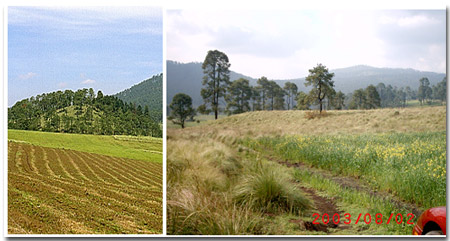
a) Fragmented habitat due to agricultural activities (Photo: Gerardo Carreón). b) Pastureland close to the border of the Chichinautzin Biological Corridor, where the sparrow has been found (Photo: Adán Oliveras de Ita).
There are no documented sightings of this bird in any of the Mexican protected areas. According maps created by Palma et al. (1999), in 1991 potential habitat was identified in Lagunas de Zempoala and El Tepozteco National Parks, but it is unknown if the species ever lived in those areas or if it lives there today. Meanwhile, La Cima, where the birds are found according to Oliveras de Ita et al. (2001), is only 8.3 km from Lagunas de Zempoala\’s border and only 1.4 km from Chichinautzin Biological Corredor\’s border (which includes both parks). The sparrow has also been documented in zones such as Coexapa of Mexico and El Capulín of Morelos, which are even closer to the protected areas, but have less available habitat and the population densities are even lower. La Cima has been recognized as an Important Bird Conservation Area (Arizmendi y Márquez Valdelamar 2000).
A search for the Sierra Madre Sparrow should be conducted in Chichinautzin Biological Corridor, especially in the two national parks within the corridor-Lagunas de Zempoala and El Tepozteco. In addition, a feasibility study for either expanding Chichinautzin Biological Corridor to include La Cima, or creating a special protected zone aimed at preserving its habitat is needed. This species survival completely depends on protecting its existing habitat.
Bibliography
Arizmendi, M.C., y L. Márquez Valdelamar. 2000. Areas de importancia para la conservación de las aves en México. CIPAMEX. México, D.F.
BirdLife International. 2000. Threatened birds of the world. Barcelona y Cambridge (Reino Unido). Lynx Edicions y BirdLife International.
González, C. 2000. Identificación de las áreas críticas para la conservación del gorrión serrano (Xenospiza baileyi). Tesis de Licenciatura. UNAM – Campus Iztacala. México, D.F. México.
Oliveras de Ita, A., H. Gómez de Silva y M. Grosselet. 2001. Population dynamics and natural history of the Sierra Madre Sparrow Xenospiza baileyi at La Cima, Mexico. Cotinga 15: 43-47.
Palma, M., A. Velázquez, F.J. Romero y G. Bocco. 1999. Zonificación de áreas prioritarias para la conservación de la biodiversidad: el caso de la región de montaña del sur de la Cuenca de México. Pp. 287-301 En: Velázquez, A. y Francisco Romero. (Comps.). Biodiversidad de la región de montaña del Sur del Valle de México. U.A.M. Xochimilco y Secretaría del Medio Ambiente, Gob. del D.D.F. México, D.F. México.
ParksWatch-Mexico: November, 2003