
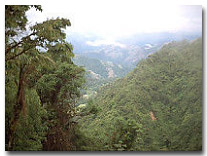
Volcán Tacaná Biosphere Reserve, created this year, is found in the Pacific side of the state of Chiapas. It is 637836 hectares and is the only representative of the Central American volcanic chain found in Mexico. Located on the Pacific slope along the border between Mexico and Guatemala and rising up to 4,000 meters above sea level the 600,000-hectare zone is distributed equally between the two countries and has a precipitation ranging from 1500 to 5000 mm/year.
The main rivers in the basin, the Coatán, Suchiate and Naranjo, together form the most important zones for water production in both Guatemala and Mexico. The Tacaná river basin provides essential goods and environmental services that form the natural assets of the livelihoods of over 1.5 million people living in some 30 municipalities throughout the basin. A limited number of livelihood strategies are used, including farming, keeping livestock and commercial (coffee) agriculture, wage labouring inside and outside the region and craft and tourism related activities. This is also a coffee producing region for both countries where organic coffee is grown.
The area is also faced with presure on its natural resources because of increasing population. Extensive and intensive agricultural practices that develop without control contribute to increasing the vulnerability of the people\’s livelihoods by eroding their natural asset base. Sedimentation, contamination, overgrazing and loss of riparian habitats are some of the immediate consequences the communities face. The communities\’ social demands include fighting poverty and marginalization and to increase their quality of life without harming the environment.
Several institutions from both countries have come together to work on an integrated management project coordinated by the World Conservation Union (IUCN) known as Project Tacaná The goal is that, \”water and other natural resources in the Tacaná basin are conserved and sustainably managed for the benefit of the people and the maintenance of natural ecosystems and biodiversity.\”
Some of the objectives are to develop local organizations that are capable of sustainably managing their natural resources, to promote environmental management and local participation (from authorities and communities), to conduct appropriate water management activities and to establish financing mechanisms for sustainable development throughout the basin.
Principle products include: (1) conducting a basin-wide assesment (a database) for use in creating the master plan and the management plan for the ecological utilization of the land; (2) capacity building for community organizations; (3) to implement in the communities successful sustainable management of the natural resources,including reforestation, agroforestry, organic coffee production, ecotourism, and diversification of agricultural activities; (4) to develop economic instruments for appropriate environmental maangement within the basin and an integrated land and water management plan.
Financial resources for the project are provided by IUCN-Mesoamerica and financing will extend through 2005.
Sources: IUCN and Mexico\’s National Commission of Natural Protected Areas (CONANP) April 2003
Photos: IUCN