
Top photo: A deforested area in Montes Azules Reserve, near Lacantún River.
Since the beginning of 2003, news reports have been announcing evictions and possible confrontations between Lacandon ethnic groups and new settlers that have apparently settled illegally in the Montes Azules Biosphere Reserve. The Lacandon ethnic group were designated as the proprietors of the reserve in a presidential decree of 1972, and again in the reserve\’s establishment decree in 1978.
Information printed in newspapers such as La Jornada talk of possible evictions and joined governmental efforts between the Marines, the National Commission of Natural Protected Areas (CONANP), and the Federal Procurator\’s Office of Environmental Protection (PROFEPA). Illegal settlements located in the southern part of the reserve, like Nuevo San Isidro and Nuevo San Rafael, have been there since 1998 and now have 44 families. These families claim to be support bases of the Zapatista National Liberation Army (EZLN). In April, the newest community declared that its members would not accept a peaceful eviction and would only leave dead. This situation has made governmental efforts difficult because they are afraid of a possible armed uprising.
According to a reporter of La Jornada, a day before the new settlers declared their intentions to stay, well-armed group of Choles and Lacandon indigenous people were headed toward Nuevo San Isidro and Nuevo San Rafael communities with the goal of removing these settlers by force. According to this news source, the group was directed by CONANP and PROFEPA officials. When they arrived at the settlements, they were met by members of the community who began a discussion that quickly turned into a heated conversation. The group of Choles and Lacandons gave the settlers eight days to evacuate their settlement and leave the reserve under the threat of death.
Also in April, other news reports stated that violent acts had started in El Paraíso community, also located in the protected area. The Lacandons went to the settlement and started fires. La Jornada reported that several homes were destroyed. La Jornada also estimated that approximately 100 hectares of forest and crops burned and that the fire almost got out of control. Before the Lacandons\’ raid, the settlers made a direct demand to Chiapas\’ Governor, Pablo Salazar Mendiguchía, that he intervene. The Lacandones again gave San Isidro and San Rafael settlers 20 days to evacuate the land. They also contacted the federal government asking for immediate intervention to find a solution.
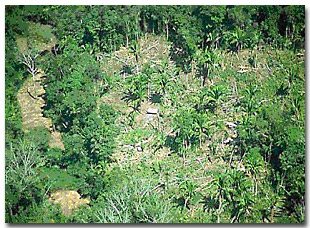
Illegal Settlement, \”Nuevo San Rafael,\” in the southern part of Montes Azules.
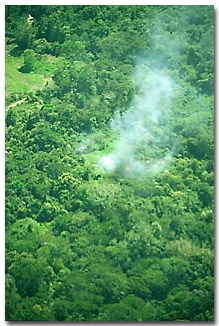
Montes Azules Reserve. Fires are one of the threats to the reserve resulting from the \”irregular\” settlements inside of the protected area.
Lacandon people from Frontera Corozal, Nueva Palestina and Lacanja visited San Isidro and San Rafael settlements most often, reminding the settlers of the new upcoming deadline and that they had to leave. Only a few days before the deadline was supposed to have ended (on May 7, 2003) did Governor Pablo Salazar agreed to meet with Lacandon leaders to put together a truce and discuss possible solutions. The Governor realized that the indigenous\’ threats against the new settlers were real. The state government will investigate each settlement and recognize the habitants that have their agrarian documents, which legitimizes their land claims and shows that they are the owners of the land they inhabit. With the recently arrived settlers, the state will try to negotiate and convince them to voluntarily abandon the new settlements. For the settlers who face eviction, the state has come up with alternatives (social, agricultural, population and development). Moreover, the state government offered help to the Lacandon people, in the form of economic resources and development programs.
On May 21, 2003, the president of the Lacandon communities, David González Chankin, continued to demand that the government relocate or evict the settlers. He said that the community has grown tired of asking for eviction, which they do not think would solve the problem anyway. He also said that in a fly-over the reserve, he could see that the settlers continue to cut down the forest\’s trees.
The information that the general Mexican public receives about deforestation by new settlers of the natural protected areas in this part of the country is not clear. For example, with this article, we highlight only two communities; one community is said to currently occupy six hectares, but in reality its holdings are larger-the land is chosen thinking in the future and how the community will grow. A study completed by Conservation International\’s Selva Maya Program found that between 1994 and 2002, there were 27 irregular settlements that affected a total of 2,268 hectares in Montes Azules Biosphere Reserve, Lacantún Biosphere Reserve and Naha Protection Area of Flora and Fauna, all protected areas are located in Chiapas.
Irregular settlements are not only causing conflicts between Lacandon communities, who have traditional rights to the land, and the new settlers; they are impacting the reserves, threatening their integrity and future sustainability.
Source: La Jornada Newspaper of MX
Photos: Gerardo Carreón
ParksWatch: May 2003