
Forest fires in Sierra del Lacandón National Park
Summary
There was chaos in the department of Peten between the March 16 and 21, 2003. A thick smoke cloud, mostly coming from the forest fires, covered the department. At the time of this writing, official information is scarce, and what does exist is contradictory. The extent of forest engulfed by flames is estimated to vary between 15,000 and 300,000 hectares. State officials have not clarified the quality of forest burned (many state that only secondary forest has burned) or the cause of fires that have resulted in the loss of part of Sierra del Lacandón and Laguna del Tigre National Parks. According to the National Council of Protected Areas (CONAP) and other governmental and non-governmental agencies, slash and burn agriculturalists are primarily responsible. But, none of this is completely true. The fires could have been prevented. However, negligence by the authorities and lack of political will ended in a slow, weak reaction-one that was insufficient to fight against this increasingly common problem in the Maya Biosphere Reserve.
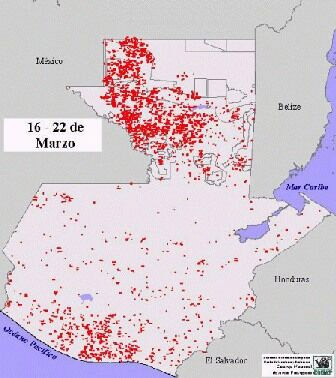
Map of the fires that occurred in Guatemala from March 16 to March 22 (CONAP)
Governmental Negligence
The authorities\’ slow reaction is mostly because they were not prepared for such a widespread emergency that was declared in Peten between March 16 and 21, 2003. Fire fighting organizations came into existence in 1998 and should have been working to prevent these kinds of disasters. One of the more important organizations is the Emergency Operations Center (COE), created in 1998 to fight the forest fires that spread throughout Peten during \”El Niño\” phenomenon. Chaired by Petén\’s governor, the COE is a consortium of institutions including the National Disaster Reduction Council (CONRED), the Army, the National Forestry Institute (INAB) and the National Council of Protected Areas (CONAP). COE was supposed to have capacity to launch a rapid response once an emergency was declared, facilitating the coordination among the participating institutions.
However, an apparently insignificant detail-failing to name a governor of Peten-provoked an almost complete void in the presidency of the COE. Since Tuesday, March 20, no real coordination among the institutions has existed and they have carried out their efforts independently while relying on modest financial resources. Negligence of the public officials, President Portillo and the Ex-Governor of Petén, Adán Regalado, meant that the COE lacked leadership in the moment when it was most needed.
President Portillo waited too long to accept the Governor\’s resignation and to appoint someone else to the position. President Portillo finally reacted on March 24th and appointed a new governor for Petén. But it was too late to remedy the fire situation because by that time the damage had already been done and recent rains had extinguished most of the fires. During COE\’s third meeting on March 20, some of those in attendance did express their opinion, albeit timidly, that appointing a new governor of Petén was urgently needed. At that time, the now Ex-Governor Adán Regalado had abandoned his responsibilities while a provisional substitute took the post.
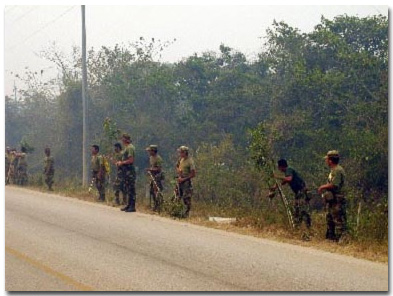
Soldiers in the milatary zone of Petén in formation to extinguish the fires near the town of Santa Elena.
This is not the only example of negligence. The issues go deeper and deserve further discussion. It is known that since the end of 2002 there was a lack of funding to fight fires. In 2002, the coffers of the National System of Preventing and Controlling Forest Fires (SIPECIF) were left empty without having assigned any teams to prevent the fires. President Portillo finally announced a transfer of funds but only after the emergency alert was already issued. At this point, it was already impossible to stop the most active fires. Did the President realize the risks widespread forest fires pose? Unless President Portillo lives totally out of touch with this country, it is undeniable that he ought to have been aware [of the threats] to some degree. After the emergency was declared, the President authorized the transfer of 8 million Quetzales. This is evidence that SIPECIF\’s lack of funding could not have been due to an actual scarcity of funds within the government\’s budget. The only possible explanation for SIPECIF\’s lack of funding was that not enough attention was given to the problem of forest fires.
Moreover, lack of political will to seriously confront Laguna del Tigre\’s grave problems is another reason more uncontrolled forest fires burned in the park that this year. Because the executive secretary of CONAP is responsible to the Guatemala\’s presidency, Petén\’s local leadership is ultimately to blame for the insufficient budget under which Laguna del Tigre operates. A pathetic result of this situation is that Laguna del Tigre National Park has only 40 park guards when at least 80 are needed.
Chaos in Petén
During the week of March 17, Petén\’s panorama was chaotic. CONAP felt overwhelmed with the announcement of the first flames in Laguna del Tigre. Pedro Pacheco, the park\’s sub-director, could not get over his amazement during our fly-over on March 19. During this time, when the situation was at its worst, the fire fighting teams were already trying to extinguish a source in Guayacán, in the northeast section of the park. Already, there were other uncontrolled fires in the west and center of the park and Guayacán\’s was growing. CONAP administrators in Petén were throwing around the theory that the fires were started by agriculturalists trying to expand the agricultural frontier. Nothing is farther from the truth. The fires in Guayacán and on the western border were burning through savannahs, which are good places for cattle but not for other agricultural activities. Only after Trópico Verde\’s insistence did Edy Girón, CONAP\’s director in Petén, recognize that they could be dealing with fires that were set intentionally in order to damage the park.
During COE\’s 3rd meeting the fires burned throughout the entire western, central and northeastern part of Laguna del Tigre, and in the southern and eastern parts of Sierra del Lacandón. On this day, even though they were discussing possible strategies, it was obvious that there was a lack of institutional coordination. An official with the Presidential Secretary of Strategic Analysis, in parallel meetings, tried to convince those in attendance that they had made it more difficult for the military region of Petén to carry out its coordination efforts. Meanwhile, they discussed creating commissions to deal with forest fires and they accepted a cellular phone donated by one of the municipal mayors present at the meeting. Still, as of this date, the 8 million Quetzales that President Portillo eventually offered had not arrived to confront the catastrophe.
Sierra del Lacandón National Park administrators did not yet know that the flames had reached virgin forest and they had been quoted in the press saying that they feared this happening. The park director\’s stress was evident to us when we advised her that we had just flown over the zone and that the fire was devouring much of the protected area. When it finally became evident that the many of the forest fires were set purposefully, the president of a well-known community association dedicated to forestry activities took the opportunity to lobby against the existence of national parks within the Maya Biosphere Reserve. The local leader hardly showed any concern for what was happening outside of the community concession. This sort of attitude makes one wonder about what type of success community participation has had in the reserve\’s conservation.
The director of biotopes for the Center for Conservation Studies in Petén (CECON), Mynor Barrios, with whom we conducted the fly-over of Laguna del Tigre Protected Biotope, decided to join forces with CONAP. One of the few signs of institutional coordination and solidarity has come from the director of CECON and CONAP\’s sub-director of Laguna del Tigre, who worked together in a critical moment while other institutions tried to figure out what they could get out of the disaster.
On March 21st, as fires continued to burn out of control in Laguna del Tigre, a soldier from military detachment located near the oils wells of Xan denied that there was any fire in the national park. Because of our insistence in asking about the thick, smoke cloud covering the protected area, he finally responded, saying that the fires were near Sayaxché. Minutes after this interchange, equipment compliments of the petroleum company passed the military detachment. This equipment sent by the company was meant to fight the fires that threatened, among other things, its own infrastructure. Another example of the pathetic response to the fires happened few days earlier, when the Army sent a few soldiers armed with branches and one pump to go fight the fires that were close to Santa Elena.
Who is behind the fires?
It is impossible to think that the fires were caused by the expanding agricultural frontier. Normally, burning for agriculture occurs just before rains begin, between April and May. Farmers do not waste efforts before the time called Lluvia de las Chicharras, which marks the beginning of planting season. A more probable explanation is that some of the fires, or at least the ones within Laguna del Tigre, were started in order to create new cattle grazing areas. Near the highway going to the petroleum wells of Xan, we could see large parcels of land, some up to several dozen hectares, that had been recently cut and burned in order to establish grazing land. However, this was not the only cause of the fires. Some of the fires were caused intentionally, an attempt against two of the most symbolic parks of Petén and meant to debilitate the protected areas system of Guatemala.
A large number of the fires were located in the savannahs of the north and western parts of Laguna del Tigre National Park, far from inhabited areas. Some theories point to the illegal poachers looking for easy prey as those responsible for the fires. Probably, some of all the theories are correct, although there exists evidence of a boycott against the parks. In Sierra del Lacandón National Park, it is obvious that there was a clear intent to destroy virgin forest. In the south, the inhabited area of the park, there were many fires, but fire also reached several kilometers into the forest in remote areas.
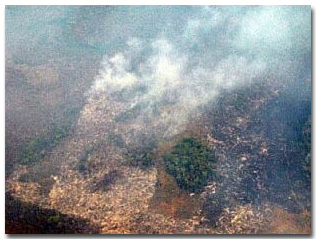
Large areas burned in Laguna del Tigre National Park.
No one benefits more from forest fires in protected areas than those who want to see the protected areas disappear. Two possible beneficiaries include the cattle ranchers, who need vast land extensions, and new settlers, who seem to be targeting land currently held as part of the national heritage. These two groups seem to be separate, isolated groups, but they frequently unite and maintain a close relationship. If the Guatemalan System of Protected Areas fails, there will be more than 2 million hectares of land available to use, for example, for cattle ranching in order to satisfy Mexican beef demand. In Laguna del Tigre and Sierra del Lacandón there are more than 300 thousand hectares of land located close to that Mexican market that some wish to enter. The cost for a potential million-dollar business, that would only favor a few people, is the entire nation\’s natural heritage.
Independent investigations continue to indicate that forest fires, new settlements and cattle are closely related phenomenons. Cattle ranching has expanded limitlessly in Laguna del Tigre over the last three years and no one has done anything to stop it. In addition, in Sierra del Lacandón National Park near the community of Poza Azul, it seems as the first speculations for cattle introduction have been carried out. The proposed Ceibo Highway-supported by the Ex-Governor, Adán Regalado, among others-is planned as a direct route to the Mexican market.
If it can be shown that zones within a protected areas system are not viable, then those areas could be opened up for timber exploitation, and oil and mining. This is not something new. Arzú\’s government in 1997 tried to open up Sierra del Lacandón and Laguna del Tigre National Parks, in addition to the multiple use zones of the Maya Biosphere Reserve, for petroleum activity. That project was stopped but only after fierce opposition from environmental and local groups. And not so coincidentally, during a field visit to Laguna del Tigre on March 21st, a petroleum engineer complained that in Guatemala oil reserve exploitation in protected areas is not permitted.
Official reaction not sufficient
Overall, the authorities\’ reaction was late and insufficient. However, not all institutions responded in the same way. CONAP of Petén had the fastest response time. The Institute of Anthropology and History (IDAEH) put itself on maximum alert to safeguard Tikal National Park. CECON and some NGOs also implemented responses, but they were too late and weak. Some institutions restricted themselves only to the area that they administer. The National Forestry Institute, the Ministry of Environment and the Ministry of Agriculture were noticeably absent-although they appeared on the scene at various moments, their presence was nothing more than symbolic.
Even if all the institutions would have had a rapid, well-coordinated response, they would have been only addressing the symptom and not the root cause. The fact is these areas, Sierra del Lacandón National Park, Laguna del Tigre National Park, and part of the western portion of the multiple use zone of the Maya Biosphere Reserve, have become ungovernable. Insistence that the forest fires were due to the advancing agricultural frontier shows either that administrators are out of touch with reality (unlikely), or that the problem has overwhelmed them. It is hard for them to realize (or admit) that the agreements they signed with the local communities in the areas are not producing the desired results. Likewise, it is difficult for them either to enforce the law with all of their power, which could mean several years imprisonment for the crimes of encroachment into protected areas or attempts against the natural heritage. Even more complicated for them is to confront drug trafficking, the illegal immigrant route, corruption, illegal deforestation; activities controlled by organized crime groups. With this perspective, it is easier for institutions to continue doing what they can, wait for something to change and hope for a miracle solution to this enormous problem.
As long as there is a lack of strong political will to deal with the problems, the lawlessness will continue and the protected area administrators will have no choice but to try to partially realize their missions and wait crouched over until the storm dies down. The political will needed is from those responsible within Guatemala\’s national government.
Conclusions
As of this writing, it is not known exactly how much forest burned. We will probably never know. Yet, this is not the most important information. It would be more important, for example, to know how many people face charges for attempting to destroy the country\’s natural heritage. At the time of this writing, there has not been one arrest, even though thousands of hectares of forest burned and there were dozens of fires in which more than one criminal hand surely contributed. Probably, no one will be charged for starting these fires, which is not so strange in a country where impunity reigns.
No one speaks about the penal responsibilities of the civil servants who neglect accusations or who support possibly illegal activities in protected areas. The lack of political will to solve the problems in protected areas is obvious. As long as Tikal continues to have twice the number of personnel per hectare than Laguna del Tigre and Sierra del Lacandón National Park (one person per every 3 thousand, 7 thousand and 6 thousand hectares respectively) it remains evident that the highest authorities have no interest in conserving Guatemala\’s tropical forest.
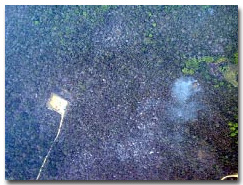
The completely burned surroundings of one of the petroleum wells of Xan.
The forest fires are a symptom of a sickness known as governmental negligence. As long as it is not cured, the symptoms will continue. In 1998, more than 140 thousand hectares of Sierra del Lacandón and Laguna del Tigre National Parks burned. The forest fires continue year after year in the same areas despite the creation of different fire fighting groups. The problem continues because it is not being attacked at the roots. The choice is clear: either a radical attitude change needs to happen among the country\’s leaders or we sit by and watch the slow, painful death of the Maya Biosphere Reserve.
ParksWatch: April 2003