
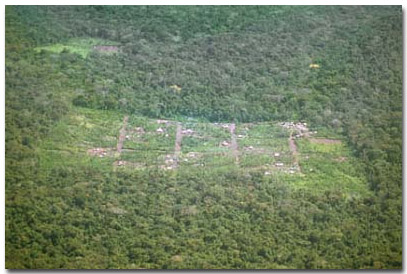
This photo depicts the area (3 hectares) deforested this year in Lacantún Reserve
As recently as early 2001, Lacantún Biosphere Reserve was still considered one of the most pristine protected areas of Mexico. However, in June 2001, the first human invasion occurred at a site called “Arroyo Cristalino,” which in English means “Crystalline Stream.” Approximately 18 hectares were cleared at that time. According to environmental monitoring reports from the Selva Maya Program of Conservation International (CI), between June 2001 and 2002, that clearing remained at 18 hectares. As of May 2002, satellite imagery documented that this area and newly established clearings near the original covered approximately 26 hectares.
In this photo, one can observe the first parcel cleared in June 2001. The clearings from 2002 can be seen in the upper left corner of the photo.
This past Februrary 27, 2003, ParksWatch-Mexico participated in a monitoring fly-over of Selva Lacandona with staff from CI and staff from Montes Azules Reserve. During the flight, they observed some of the 25 illegal settlements within Montes Azules Reserve and the invaded area within Lacantún. Because of the pilot’s skill with the small aircraft Cessna 180, we were able to identify a newly cleared area of about 3 hectares. This signifies that the settlers continue to carry out destructive activities in the area.
Lacantún Biosphere Reserve is located in southeastern Chiapas and is part of the protected areas system known as the Selva Maya. It makes up the northern range of the tropical forest, “selva alta perennifolia.” The reserve is an important source of environmental services in Mexico and in the world.
The areas affected by these invasions are property of the Lacandona Community, who has filed claims to the authorities, including the Federal Procurator for Environmental Protection (PROFEPA), the National Commission of Natural Protected Areas (CONANP) and agricultural authorities. Up until this point, the authorities have responded to these claims indicating that they will enter into negotiations with the perpetrators, to [hopefully] come to a peaceful settlement. In the meantime, illegal activities such as poaching wild species and deforestation continue in a race against time.
We will not see the trees like the ones we lose today for another 80 to 100 years and many of the fauna and flora that are destroyed with the forest will be lost forever.
ParksWatch: March 2003